Iran Claims Missile And Drone Strikes On US Naval Fuel-Support Pier In Kuwait
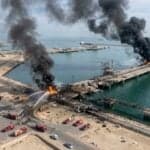


Iran’s Islamic Revolutionary Guard Corps (IRGC) said it launched missile and drone strikes on a US naval fuel-support pier in Kuwait and several US-linked military facilities in Bahrain, claiming the attacks were carried out in retaliation for overnight US strikes on Iranian territory.
In its 28th wartime statement, published by the IRGC-affiliated Tasnim News Agency, the force said it targeted the US Navy’s fuel-support pier at Al Ahmadi Port in Kuwait, a combat aircraft site at Bahrain’s Sheikh Isa Air Base, a US communications centre in Kuwait and a US intelligence data centre at Bahrain’s Batelco facility.
The IRGC said the attacks were part of the 19th wave of its “Operation Nasr-2”. The claims have not been independently verified by international authorities or the United States.
Iranian military statements said the strikes hit aircraft hangars, fighter jet parking areas and fuel tanks at Sheikh Isa Air Base.
Tehran claimed the base had been used by the United States to launch military operations in the region. Iranian state media also reported that a warehouse used for US military drones in Bahrain was struck.
The IRGC also claimed it destroyed the US fleet’s fuel-support dock at Al Ahmadi Port and a US communications facility in Kuwait. It further said its forces fired shore-to-sea cruise missiles at a US vessel in the northern Indian Ocean, although there has been no confirmation from Washington.
Iran said the operation was launched in response to US strikes carried out the previous night. According to Al Jazeera, the US attacks hit the coastal city of Sirik and Qeshm Island on July 18-19. The IRGC described them as the eighth consecutive night of US attacks on Iranian territory.
The operation followed the 18th wave of Operation Nasr-2, during which Iran said it struck Camp Arifjan and the radar at Ali Al Salem Air Base in Kuwait.
Iran said the earlier attacks targeted military personnel, equipment and infrastructure, while the latest wave focused on infrastructure.
Bahrain’s Defence Forces said they intercepted and destroyed several Iranian aerial attacks after air raid sirens sounded repeatedly across the country.
Bahrain’s Interior Ministry urged residents to remain calm and move to the nearest safe location as warning sirens were activated for the fifth time within a few hours.
The Bahraini military said its air defence systems remained on the highest level of readiness, adding that the use of missiles and drones against civilians and private property violated international humanitarian law.
In Kuwait, authorities temporarily suspended operations at Kuwait International Airport after missile and drone attacks led to the temporary closure of the country’s airspace. Kuwait Airways later said most flights had resumed.
Kuwait Petroleum Corporation said one of its vital oil sector facilities came under repeated attacks, causing injuries and significant material damage. The company said injured workers received medical treatment and the affected site was evacuated in coordination with authorities.
Kuwait’s Fire Force said several firefighters and one worker were injured while responding to fires at two locations hit during the attacks.
Kuwait’s Ministry of Electricity, Water and Renewable Energy said one component of a power generation and water desalination plant caught fire after the attacks.
Several electricity generation units were disconnected as a precaution while emergency plans were activated to maintain electricity and water supplies. Earlier reports also said two power generation and desalination plants had been hit.
According to state news agency KUNA, Kuwait’s Foreign Ministry said the repeated attacks on vital infrastructure showed a systematic campaign targeting civilian facilities and essential services.
It added that Kuwait reserved the right to take all necessary measures to protect its territory, security and critical infrastructure under its right to self-defence.
Jordan’s Armed Forces said they intercepted and shot down four drones that entered the country’s airspace over the previous 24 hours, with no casualties or material damage reported.
The IRGC also claimed it carried out missile and drone strikes on the US-operated Al Azraq Air Base in Jordan, alleging that two American fighter jets were destroyed and several others damaged. Jordan has not confirmed any damage to the air base or US aircraft.
The latest Iranian attacks followed what the United States described as the seventh consecutive night of strikes across Iran aimed at degrading Iran’s military capabilities, including logistics networks, surveillance systems, coastal infrastructure and assets linked to operations in the Strait of Hormuz.
Iranian media reported explosions in Bandar Abbas, Lar, Ahvaz, Sirik, Qeshm and Yazd following the US attacks. Washington has said the campaign is intended to reduce Iran’s ability to threaten commercial shipping through the Strait of Hormuz.
The latest exchange has expanded the conflict beyond direct military targets to include fuel, energy, communications and other infrastructure across the Gulf. Kuwait temporarily halted airport operations, while damage was also reported at oil, power and water facilities.
Brent crude settled at $88.10 a barrel on July 17, up more than 14% during the week.
The military exchanges have continued despite a Pakistan-brokered memorandum of understanding signed in June that aimed to end hostilities and establish a lasting peace agreement between the United States and Iran.
Amid the deteriorating security situation, the US Embassy in Beirut advised American citizens not to travel to Lebanon and urged those considering travel through the Middle East to reconsider their plans.
The US Embassy in Jerusalem also warned Americans against travelling to Gaza, northern Israel and areas near the Egyptian border, except through the Taba crossing.
References: iranintl, houseofsaud
Want to read more?
Check out the full article on the original site