Iran Attacks U.S Navy’s AI & Drone Operations Infrastructure In Bahrain
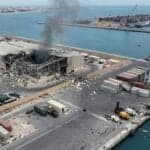


Iran said it carried out near-simultaneous strikes on three facilities hosting U.S. military assets in Bahrain and Kuwait, targeting infrastructure linked to American drone, naval and Marine operations, while satellite imagery reviewed by ABC News showed damage at several U.S.-linked sites across the Gulf since fighting resumed earlier this month.
The Islamic Revolutionary Guard Corps (IRGC) said its naval forces struck drone maintenance and repair hangars at Bahrain’s Al-Sakhir Airport before targeting infrastructure linked to the U.S. Navy’s Task Force 59 at Salman Port.
According to Iran, the unit uses unmanned vessels, artificial intelligence and surveillance technology to support U.S. operations in the Persian Gulf.
Tehran also said a third strike set fire to and “completely destroyed” sheds used by U.S. Marine special operations forces at Camp Arifjan in Kuwait, a major U.S. logistics hub.
The United States, Bahrain and Kuwait have not independently confirmed the extent of the damage claimed by Iran.
Military tensions continue across the Gulf, where U.S. forces support naval operations and maritime security around the Strait of Hormuz, one of the world’s busiest energy shipping routes.
An ABC News analysis of satellite imagery and video found that at least three bases hosting U.S. assets in the Middle East have been damaged in Iranian-claimed missile and drone strikes since hostilities with the United States resumed in early July.
According to the analysis, military facilities in Bahrain, Jordan and Qatar showed signs of damage. A former United Nations base camp and an industrial area in Kuwait were also hit.
While the overall operational impact appears to be limited, the attacks show that Iran remains capable of carrying out strikes despite ongoing U.S. military operations, Sam Lair, a fellow at the Foreign Policy Research Institute, told ABC News.
U.S. Central Command (CENTCOM) declined to comment on the reported strikes.
Ken Pollack, vice president for policy at the Middle East Institute and a former CIA military analyst, told ABC News that Iran appears to be choosing military targets it believes it can hit while limiting the risk of further escalation.
He said Iran has focused on military bases rather than civilian targets, reducing the likelihood of a stronger U.S. response. Pollack also said Iran may have identified weaknesses in U.S. and Gulf air defences after months of attacks.
Satellite images dated July 12 reviewed by ABC News showed apparent damage to a warehouse building at the U.S. Navy’s Fifth Fleet headquarters in Bahrain.
Lair said the images appeared to show a hole in the warehouse roof. He described the location as symbolically important because it shows Iran can still threaten U.S. military facilities in the Gulf.
Separate satellite imagery from July 12 also showed the southern section of a building at Al Udeid Air Base in Qatar destroyed.
Lair said the damage could make it more difficult to support flight operations from the base, although he added that the overall operational effect remains unclear. He noted that much of the base’s sensitive equipment and many personnel had reportedly been removed before the conflict intensified.
He said the strikes suggest Iran still has the ability to target a wide range of locations across the region despite the continuing U.S. air campaign, including infrastructure linked to operations around the Strait of Hormuz.
On Monday, President Donald Trump said the United States was “knocking out all of” Iran’s offensive capabilities and announced the reinstatement of a naval blockade on commercial ships transiting the Strait of Hormuz.
Pollack said Iran does not need to stop all trade through the Strait of Hormuz to achieve its objectives.
“It’s important to remember that for the Iranians, they don’t need to shut down all of the trade in the Strait of Hormuz,” Pollack said. “They don’t need to destroy every city in the Arabian Peninsula. All they need to do is to be able to threaten to do so.”
He added that repeated attacks on Gulf states could have serious long-term consequences for the region.
References: TOI, abcnews
Want to read more?
Check out the full article on the original site