Chinese Missile Destroyer Conducts First Known Live-Fire Drill In Japan’s Waters
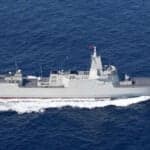


A Chinese navy destroyer carried out a live-fire exercise inside Japan’s exclusive economic zone (EEZ), marking the first time Tokyo has publicly reported such an incident.
Japan lodged a protest with China and stepped up air and sea surveillance, saying the drill was part of growing military cooperation between China and Russia.
The drill took place on Sunday about 180 km (110 miles) southwest of Okinotori, Japan’s southernmost island.
According to Japan’s Defence Ministry, the Chinese warship used live machine-gun fire after warning nearby ships over radio that the exercise would take place.
Chief Cabinet Secretary Minoru Kihara said Japan protested through diplomatic channels, saying the drill “could have endangered the navigation of nearby ships.” He said Tokyo would continue monitoring Chinese and Russian military activities in the waters around Japan.
The exercise is the first live-fire drill by a Chinese naval vessel inside Japan’s EEZ to be publicly disclosed by Japan’s Defence Ministry.
Japan said it views the operation as part of closer military cooperation between China and Russia, whose joint naval and air activities around Japan have increased in recent years.
According to Japan’s military, four ships – a Chinese Renhai-class guided-missile destroyer, a Luyang III-class guided-missile destroyer, a Fuchi-class replenishment ship and a Russian Steregushchiy-class frigate, were first spotted at around 2 a.m. on Sunday about 330 km southwest of Okinotori.
The Luyang III-class destroyer later carried out the live-fire drill about 180 km southwest of the island while Japan’s Maritime Self-Defense Force monitored the exercise and gathered intelligence.
Defence Minister Shinjiro Koizumi, speaking at the Farnborough International Airshow in England on Monday, said Chinese and Russian naval vessels were conducting joint navigation operations around Japan.
“At this moment, Chinese and Russian naval vessels are conducting joint navigation operations in the waters surrounding Japan,” Koizumi said, adding that the latest drill was another sign of deepening military cooperation between the two countries.
Kihara said nearby vessels were informed by radio immediately before the live-fire exercise about its location and duration.
China disputes Japan’s claim over the waters surrounding Okinotori, arguing that the remote feature is a reef rather than an island and therefore does not generate an EEZ under international law. Japan maintains that Okinotori is an island and claims a 200-nautical-mile (370-km) EEZ around it.
Military activities inside another country’s EEZ are not prohibited under the United Nations Convention on the Law of the Sea (UNCLOS), but live-fire drills have previously caused diplomatic friction because they may pose risks to nearby shipping.
Japan said a Chinese aircraft carrier and a research vessel entered the waters around Okinotori in 2025, but this is the first time it has publicly reported a foreign navy firing live ammunition inside its EEZ.
The exercise follows a series of joint Chinese-Russian military operations near Japan. Last month, the two countries carried out joint strategic air patrols involving bombers over the Sea of Japan, the East China Sea and the western Pacific. Their navies have also conducted joint exercises this month.
Ties between Japan and China have worsened since Prime Minister Sanae Takaichi’s comments on Taiwan in late 2025 drew criticism from Beijing.
Japan has also strengthened its defence posture and expanded security cooperation with partners in the Indo-Pacific and Europe.
Separately on Monday, another maritime confrontation took place in the South China Sea. A Chinese vessel approached the Philippine-controlled Second Thomas Shoal, prompting the Philippine navy to deploy rubber boats to block its advance.
The Philippines said one of its sailors suffered a serious head injury after being struck with a wooden baton by a Chinese crew member.
China disputed that account, saying its personnel issued warnings and that Philippine crew members attacked first with long poles and other objects.
The incident came ahead of talks between the Chinese and Philippine foreign ministers during an Association of Southeast Asian Nations (ASEAN) meeting in Manila.
U.S. Secretary of State Marco Rubio criticised China’s actions, saying they undermined regional peace and stability.
In an article published in Philippine media, Rubio reaffirmed the United States’ commitment to freedom of navigation in Southeast Asia and warned that control of key regional waters by a country willing to use trade as a geopolitical tool could threaten regional security and economic stability.
References: The Guardian, Reuters
Want to read more?
Check out the full article on the original site