Asian Refiners Seek To Move Saudi Crude Via Suez Canal Route After Houthi Naval Blockade
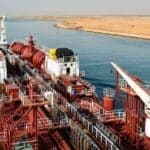


Asian refiners are looking at moving Saudi crude through the Suez Canal and around Africa after Yemen’s Iran-aligned Houthis said they would impose a naval blockade on Saudi Arabia.
On Tuesday, two oil tankers carrying Saudi crude to Asia turned back in the Red Sea after Houthi threats, while vessel traffic through the Strait of Hormuz fell further at the start of the week.
Industry experts and analysts said shipping crude west from Saudi Arabia’s Red Sea port of Yanbu to Egypt, through the Suez Canal and around Africa’s Cape of Good Hope before heading to Asia, could add up to four weeks to the journey compared with the usual route from Yanbu to the Arabian Sea. The longer voyage would also increase freight and fuel costs.
Ship-tracking data from LSEG and Kpler showed the Liberia-flagged tanker Rodos, carrying crude from Yanbu to India’s west coast, was sailing west and signalling the Suez Canal on Tuesday.
South Korean refiner Hyundai Oilbank was also seeking a Very Large Crude Carrier (VLCC) on Tuesday to load crude at Yanbu, with the option of using the Suez Canal and Egypt’s SUMED pipeline before continuing to South Korea, according to a shipping source.
A fully loaded VLCC cannot pass through the Suez Canal because of draft restrictions.
Instead, shippers usually move part of the cargo through Egypt’s SUMED pipeline on the Red Sea side, allowing the tanker to pass through the canal with a lighter load.
The vessel then reloads the crude on the Mediterranean side after crossing the canal.
The shipping source said charterers could choose whether to use the SUMED pipeline and the Suez Canal depending on conditions, or if the Bab el-Mandeb Strait, the southern entrance to the Red Sea, becomes fully blocked.
The cost of any route change would be calculated later.
The Suez Canal and the SUMED pipeline are commonly used to move crude from the Red Sea to Europe.
“Changing behaviour by tankers tells us that they are taking the threats seriously,” said Matt Smith, commodity research director at Kpler.
Smith said the disruption comes at a difficult time for Saudi Arabia, as shipments of its crude oil and petroleum products through the Bab el-Mandeb Strait reached a record of more than four million barrels per day last month.
References: Reuters, Asiaone
Want to read more?
Check out the full article on the original site