World’s First 10,800-Vehicle Car Carrier Equipped With 200-kW Solar Power System Delivered
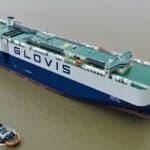


China has delivered the world’s first 10,000-vehicle-class car carrier fitted with a photovoltaic power generation system.
The 10,800-vehicle liquefied natural gas (LNG) dual-fuel Pure Car and Truck Carrier (PCTC) was delivered on Tuesday by Guangzhou Shipyard International (GSI) to South Korea’s Korea Ocean Business Corporation (KOBC) through a remote online signing ceremony held with China Shipbuilding Trading Co., Ltd.
The vessel will be leased to Hyundai Glovis and deployed on shipping routes connecting Asia, Southeast Asia, North America and Europe.
According to GSI, it is the fourth 10,000-vehicle-class car carrier built by China and the first in the world to be equipped with a photovoltaic power generation system.
The ship combines conventional fuel and LNG propulsion with a 200-kilowatt peak solar power system, a shaft generator and compliance with the International Maritime Organization’s (IMO) Tier III emission standards. GSI said this makes it the most energy-efficient vessel in the series.
The solar system can generate around 1,000 kilowatt-hours of electricity each day with 5.5 to seven hours of sunlight. The electricity is used to support the ship’s onboard operations, helping reduce fuel consumption and improve energy efficiency.
The vessel was jointly designed by GSI and the Shanghai Merchant Ship Design and Research Institute. It has received classification from Norway’s Det Norske Veritas (DNV) and South Korea’s Korean Register (KR), allowing it to operate worldwide without trading restrictions.
The car carrier is 230 metres (755 feet) long, 40 metres (131 feet) wide and has a draft of 10.5 metres (34.4 feet). It can sail at speeds of up to 19 knots.
Its LNG storage tanks can hold enough fuel for an entire voyage without the need for refuelling, according to GSI.
The ship has 14 vehicle decks, including nine fixed decks and five adjustable decks, enabling it to transport passenger cars, vans, heavy trucks, trailers carrying freight containers and other large vehicles.
In addition to vehicles, it can also carry certain packaged dangerous goods covered under the International Maritime Dangerous Goods (IMDG) Code.
References: interestingengineering, Global Times
Want to read more?
Check out the full article on the original site