Latin America’s First Regional Submarine Hub Anchored By Next-Gen Design
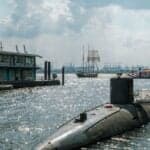


South Korea’s HD Hyundai Heavy Industries (HHI) and Peru’s state-owned shipbuilder SIMA have unveiled the HDS-MGP, a next-gen submarine concept for the Peruvian Navy.
After the basic design phase was completed, the project has moved towards industrial qualification and construction, which has laid the foundation for a Latin American submarine construction and sustainment hub.
Derived from HD Hyundai’s HDS-1500 export design, the HDS-MGP (Hyundai Design Submarine – Marina de Guerra del Perú) is a 65 m long and 1,500-tonne submarine.
This design has been customised for the Peruvian Navy’s experience and requirements in sync with the oceanographic conditions on the Pacific Coast.
The project not only aims to replace Peru’s old submarine fleet, but also highlights the country’s aim to build independent defence manufacturing capabilities.
This also marks a progression in the alliance between HHI and SIMA. Following a 2024 contract to build 4 surface vessels for Peru, the companies signed a submarine development MOU and formalised a joint development agreement in late 2025.
HHI will help SIMA in constructing, maintaining, and supporting the submarines while establishing a strong domestic defence base.
However, transitioning to local production in Peru has its own challenges. Unlike surface ships, submarine pressure hulls are much more complex.
They need to be built in sections, aligned and then welded precisely, which demands rigorous engineering and testing so they can withstand the enormous pressure in the deep sea.
Although SIMA has considerable shipbuilding experience, submarine construction introduces new difficulties like maintaining a controlled manufacturing environment, strict quality assurance, specialised testing facilities for submarines, acoustic engineering and systems integration.
According to reports, to achieve its long-term goals, SIMA will have to develop competencies in
design management, supplier qualification, configuration control, engineering documentation, and lifecycle support.
It will also need specialists including naval architects, hydrodynamicists, acoustic engineers, combat systems integrators, quality control personnel, and project managers for the submarine project.
Additionally, high-tech components including sonar, combat management systems, propulsion machinery, and acoustic treatments will be sourced from other countries in the initial phases before local supply chains can meet these demands.
If the program transitions into local production, Peru could serve as a gateway for submarine construction and maintenance across Latin America.
Want to read more?
Check out the full article on the original site