China Installs World’s Largest Offshore Wind Converter Station In South China Sea
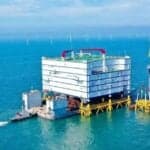


China has installed the world’s largest offshore converter station in the South China Sea, a project designed to transmit offshore wind power to the mainland and supply around 6 billion kilowatt-hours (kWh) of clean electricity each year once it enters commercial operation.
The facility, called the “Heart of Offshore Wind,” was installed on July 23 about 100 kilometers (62 miles) off the coast of Yangjiang in Guangdong Province.
The project has now entered its final stage, with subsea cable installation and offshore-onshore joint testing underway before commercial operations begin.
According to China’s State-owned Assets Supervision and Administration Commission (SASAC), the project is the world’s first ±500-kilovolt (kV), 2,000-megawatt (MW) flexible direct current (DC) offshore converter station.
Once operational, it will transmit electricity generated by offshore wind farms to the Guangdong-Hong Kong-Macao Greater Bay Area and is expected to reduce carbon dioxide emissions by nearly 5 million metric tons each year.
The converter station was installed in about seven hours using a “float-over” installation method because the upper platform was too heavy to be lifted by any available domestic heavy-lift vessel.
The station consists of two main structures: a seven-story steel superstructure and a jacket foundation fixed to the seabed.
The upper platform is 85.5 meters (280 feet) long, 82.5 meters (271 feet) wide and 44 meters (144 feet) high, with a weight of about 25,000 metric tons.
It is supported by a jacket foundation measuring 82 meters (269 feet) long, 57 meters (187 feet) wide and 69 meters (226 feet) high, weighing about 17,000 metric tons.
The foundation is secured to the seabed by eight piles designed to withstand strong winds, large waves, ocean currents, corrosive seawater, dense sea fog and frequent typhoons.
To complete the installation, engineers used the semi-submersible heavy-lift vessel Xiang Tai Kou to position the platform over the jacket foundation.
The operation relied on tidal movements and the vessel’s dynamic positioning system to guide the platform into place.
During the installation, the gap between the upper platform and the foundation was about 150 millimeters (6 inches) on each side. Rubber fenders and specialised coupling devices helped absorb impacts and align the platform before it was secured.
Project teams monitored weather forecasts from several services before choosing a window with suitable wind and sea conditions. The installation operation began shortly after 7 a.m. on June 4 and was completed in around seven hours.
SASAC said the “Heart of Offshore Wind” has the world’s highest voltage and the largest transmission capacity among offshore wind power flexible DC transmission projects.
The project is now undergoing subsea cable connection and offshore-onshore joint testing. Once commissioned, it is expected to deliver about 6 billion kWh of clean electricity each year while reducing annual carbon dioxide emissions by nearly 5 million metric tons.
References: interestingengineering, CGTN
Want to read more?
Check out the full article on the original site