Iran Says It Still Controls Strait Of Hormuz After Trump Halts U.S. Bombing Campaign
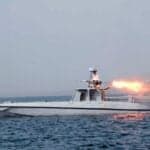


Iran said on Monday it remained in control of the Strait of Hormuz and had not sought to resume peace talks with the United States after President Donald Trump halted a two-week bombing campaign that U.S. military commanders reportedly believed had reached its limits.
The pause in fighting eases immediate concerns over further military escalation in one of the world’s most important oil shipping routes.
However, Tehran’s insistence that it still controls navigation through the Strait of Hormuz leaves uncertainty over commercial shipping and future U.S.-Iran negotiations.
Trump halted the bombing campaign over the weekend after 13 straight nights of airstrikes that led Iran to launch retaliatory attacks on U.S. military bases. Iran said it would also suspend its attacks as long as the U.S. pause remains in place.
A U.S. official told Reuters that senior military commanders advised Trump they were running out of targets.
The official said Chairman of the Joint Chiefs of Staff General Dan Caine had also raised concerns that air defence weapons protecting U.S. bases in the region were being depleted.
Several U.S. media outlets, including The New York Times, CNN and Axios, also reported that military and civilian advisers had recommended ending the campaign.
U.S. Ambassador to the United Nations Mike Waltz said on Sunday that Trump paused the bombing to allow room for negotiations.
Iran, however, denied it had asked to restart talks with Washington.
Foreign Ministry spokesperson Esmail Baghaei told a televised news conference that reports claiming Iran had requested negotiations with the United States were “fabricated.”
While messages continue to be exchanged through mediators and Iran has not abandoned diplomacy, he said seeking talks with Washington was “not in our DNA.”
Tehran also sought to show that the U.S. bombing campaign had not changed its position on the Strait of Hormuz, one of the world’s most important waterways for oil exports.
Several Iranian state media outlets, citing an informed source, reported that Iranian authorities turned back six “offending ships” on Monday morning after they attempted to pass through the strait without Iranian permission. One of the vessels was said to have been involved in “an accident.”
“As previously announced, the traffic route in the Strait of Hormuz is the route specified by Iran, and other routes are contaminated and have no way out,” the source was quoted as saying.
The dispute centers on competing shipping routes through the strait.
Trump launched the renewed bombing campaign after Iran fired on ships using a U.S.-recommended route through the Strait of Hormuz that passes closer to Oman’s coast.
Iran says ships should instead use a channel closer to its own coastline, where it says it controls transit and plans to impose transit fees.
The pause in the U.S. bombing campaign helped ease concerns over disruptions to global oil supplies.
Brent crude, which briefly rose above $100 a barrel last week for the first time since May, fell by more than 8% on Monday morning to just under $89 a barrel.
Despite the pause, tensions in the region remained.
Jordan said it shot down two drones on Monday, while Iraqi security sources reported drone strikes on a base used by Iranian Kurdish opposition fighters in northern Iraq. No casualties were reported in either incident.
The two-week U.S. bombing campaign killed many people in Iran and damaged bridges, tunnels and military targets in the country’s south, according to the reports.
Iran’s retaliatory attacks killed four U.S. service members stationed at bases in neighboring Arab countries. Tehran also struck civilian infrastructure in Gulf states, saying the attacks were retaliation for U.S. strikes on civilian targets.
Last week, Iran’s Houthi allies threatened to block Saudi Arabia’s oil industry in the Red Sea, raising concerns over global energy supplies and pushing oil prices higher.
The halt in U.S. bombing leaves uncertainty over how Washington plans to achieve Trump’s stated goal of ending Iran’s control over the Strait of Hormuz.
Washington and Tehran agreed in June to hold talks by the end of August on issues including Iran’s nuclear program.
However, both sides continue to disagree over the agreement’s wording on the Strait of Hormuz. Washington says it requires freedom of navigation, while Iran argues it gives Tehran the authority to supervise transit through the waterway.
Iran is also seeking to formalise its position through an agreement with Oman, which controls the opposite side of the strait.
A senior Omani delegation visited Tehran over the weekend for talks on the Strait of Hormuz, which Baghaei said had gone well.
According to reports carried by state media in Qatar, the United Arab Emirates and Saudi Arabia, the foreign ministers of the three countries also held separate phone calls with Oman’s Foreign Minister Badr Albusaidi on Monday to discuss the strait.
Israeli Prime Minister Benjamin Netanyahu, who joined Trump in launching the war in February but has not taken part in the U.S.-Iran negotiations, is expected to meet the U.S. president in Washington early this week.
References: The Hindu, Deccan Herald
Want to read more?
Check out the full article on the original site