Video: US Navy Tests First Live-Fire GARC Kamikaze Drone Strike Against USS Peleliu
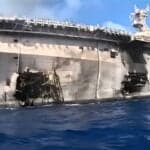


The U.S. Navy has used its Global Autonomous Reconnaissance Craft (GARC) as a one-way attack drone boat in a live-fire exercise for the first time, targeting the decommissioned amphibious assault ship USS Peleliu during the Rim of the Pacific (RIMPAC) 2026 exercise near Hawaii.
The July 17 strike was carried out by the Navy’s Unmanned Surface Vessel Division 32 (USVDIV-32), which deployed two GARC unmanned surface vessels during a SINKEX (sinking exercise).
The attack formed part of a coordinated strike package in which the target had already been hit by submarine-launched Harpoon missiles, air-launched anti-ship weapons, land-based missiles and helicopter-fired precision weapons.
The GARCs were sent in after those attacks and detonated near the ship’s waterline, adding localised structural damage and flooding to the damage already inflicted on the vessel.
The exercise allowed the Navy to evaluate how small autonomous surface vessels could be used alongside conventional weapons during large-scale naval operations.
RIMPAC 2026, held between June 24 and July 31, involved 30 nations, about 30 ships, five submarines, more than 190 aircraft, 15 national land forces and over 30,000 personnel.
The exercise also allowed the Navy to integrate the GARC into a multinational command-and-control network.
Video released by the U.S. Navy after the exercise showed unmanned surface vessels operating around the heavily damaged USS Peleliu.
The footage showed extensive damage around the waterline and water entering the ship after multiple strikes. According to the Navy, the footage was recorded by the second GARC after the attack.
Sarah Weinstein, the first commanding officer of USVDIV-32, said in a LinkedIn post that she was “honored that USVDIV-32 was given the opportunity to execute the Navy’s first GARC Live Fire during RIMPAC 2026.”
“It was incredible to watch my team execute with precision, and we were thrilled to provide a perspective of the former USS Peleliu that isn’t often captured in a SINKEX,” she said.
According to The War Zone, two GARCs took part in the exercise, although only one carried out the one-way attack. The report said the vessel used Anduril’s Lattice autonomy software and carried a payload of up to 1,000 pounds, although it was not clear how much of that weight was the explosive charge.
Follow-on strike after larger weapons
Unlike missiles or aircraft used in the opening phase of an attack, the GARC was employed after the target had already sustained heavy damage.
By entering the battle later, the unmanned vessel was able to attack a ship whose sensors, weapons, electrical systems and damage-control capability had already been degraded. The exercise tested whether a small autonomous craft could exploit vulnerable areas exposed after earlier strikes.
The Navy said such vessels could be directed toward damaged sections of a ship’s hull, machinery spaces, stern or well deck.
Their low profile and small radar signature could also make them harder to detect while operating close to the sea surface, particularly in an environment filled with smoke, floating debris and electronic interference.
USS Peleliu, a Tarawa-class amphibious assault ship, measured about 250 meters in length with a beam of 32.5 meters and a draft of 8.2 meters.
The ship displaced about 39,438 long tons at full load and could carry more than 2,800 personnel, including sailors, aviation crews and embarked Marines.
The vessel featured a full-length flight deck, aviation hangar, well deck, vehicle storage areas, engineering compartments, fuel tanks, magazines, workshops, medical facilities and command spaces.
During service it operated AV-8B Harrier attack aircraft, MV-22 Ospreys, CH-53 heavy-lift helicopters, CH-46 transport helicopters, AH-1 attack helicopters and UH-1 utility helicopters.
Even if the ship remained afloat, damage to machinery spaces, electrical systems, aviation fuel infrastructure or the well deck could significantly reduce its ability to support amphibious operations.
References: twz, armyrecognition
Want to read more?
Check out the full article on the original site