World’s Only Floating Nuclear Power Plant Passes Strictest 2-Week Safety Review In Russia
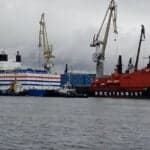


World’s only floating power plant in Russia, the Akademik Lomonosov, has successfully passed a 2-week safety review conducted by a 13-member team from the Moscow Center of the World Association of Nuclear Operators. The auditing agency was founded in 1989 and promotes best safety standards across nuclear facilities in the world.
The evaluation was conducted at the Port of Pevek in the Arctic, where experts monitored the daily operations and checked the technical documents of the facility, while another representative of the firm from China inspected the plant’s administrative division in Saint Petersburg.
While conducting the evaluation, the team focused on administration, maintenance, repairs and engineering support, operating experience, emergency preparedness, and other fields, Rosatom mentioned in a press release.
The report prepared by the body revealed that a few technical areas needed improvement compared to the review conducted in 2022.
“These findings rank the FNPP on par with Russia’s top nuclear power plants, including the Balakovo and Kalinin NPPs,” added Viktor Yelagin, Director of the FNPP.
The floating power plant has been named after a famous 18th-century scientist of the same name. The vessel is also known as the world’s only functional floating plant, which supplies electricity and heating to the local grid for isolated communities in polar regions.
The facility is a non-self-propelled steel barge which is permanently linked to coastal mooring infrastructure. The 144 m long and 30 m wide vessel has a 21,000 ton displacement and is equipped with two KLT-40S reactor systems, similar to the ones used on icebreakers.
Every reactor delivers an electrical capacity of 35 MW, and offers a capacity of 70 MW for the entire plant. The reactor cooling loops and steam generators are enclosed by containment barriers to shield them against Arctic winds, storms and waves.
The reactor of the plant needs to be refuelled once every three years, allowing it to work continuously for longer periods of time.
With an estimated life span of almost five decades, the world’s only floating power plant functions without harming the pristine environment in the far north.
It has storage compartments inside the hull for keeping spent nuclear fuel and operational waste
Generated throughout its operational life.
Once it nears the end of its life, it will be towed to a shipyard and decommissioned. The spent nuclear fuel and radioactive waste will be stored in a facility on mainland Russia, and nothing will be left in the Arctic.
Want to read more?
Check out the full article on the original site