2nd Qatari-LNG Tanker Hit By Iran In Hormuz While 22 Chinese Ships Safely Cross Red Sea Without Harm
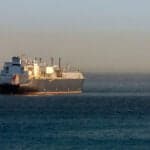


A Bermuda-flagged LNG tanker carrying Qatari gas was struck by a likely Iranian projectile near Oman’s coast, while Chinese-linked vessels continued to sail through the Red Sea without reported incidents, showing different security conditions across two major maritime routes.
GASLOG SHANGHAI (IMO 9600528), a 285-metre Bermuda-flagged LNG carrier, was hit around 11 nautical miles northeast of Limah, Oman, on July 31, according to maritime security assessments.
The vessel was carrying Qatari LNG loaded around July 27 and suffered damage to its engine room, with no casualties reported.
GasLog confirmed that all crew members were safe and said the vessel remained stable after the incident.
The UK Maritime Trade Operations (UKMTO) said a nearby Liberia-flagged vessel reported seeing a large splash and explosion close to GASLOG SHANGHAI, although it did not report any damage.
The attack was the second confirmed strike on Qatari LNG cargo in a month. No group has claimed responsibility for the incident, but Iran has previously warned vessels using the U.S.-approved southern corridor of the Strait of Hormuz.
The Islamic Revolutionary Guard Corps (IRGC) later claimed it had struck and disabled two tankers attempting to use the southern corridor under U.S. air escort.
It also said four other vessels turned back after receiving warnings. The IRGC said the vessels were directed by U.S. Central Command, although CENTCOM has not confirmed the claim.
A Liberia-flagged VLCC of around 330 metres was identified as one of the vessels suspected in the reported incident. The tanker had begun moving eastbound on July 30 and was last positioned around 45 nautical miles west of Khasab on July 31.
The IRGC also released video showing MINOAN GLORY (IMO 9364447), a Liberia-flagged bulk carrier, making a U-turn in the southern corridor after what it described as a warning. The 225-metre vessel has remained AIS-dark since July 31.
Another vessel, KAVOMALEAS, remains on fire near Larak Island 12 days after being struck. Satellite imagery showed smoke returning on August 1 after no visible smoke was detected during July 26 and July 30 observations. The crew remains off the vessel, and no salvage operation has been reported.
Different shipping patterns in the Red Sea
While shipping activity around the Strait of Hormuz has faced increased security concerns, vessel movements through the Red Sea have shown a different pattern.
Twenty-two Chinese-linked vessels transited the Bab el-Mandeb Strait and called at Saudi ports between July 20 and August 2 without any reported incidents, according to Windward assessments.
During the same period, Houthi forces struck four Saudi tankers- ENCELIA, LAYLA, NCC MASA and NCC GHAZAL.
Saudi Arabia announced a 14-country maritime coalition on July 30, headquartered in Riyadh, to protect shipping routes through the Bab el-Mandeb, Red Sea and Gulf of Aden.
Commercial operators have also changed routes. Six Saudi-flagged VLCCs are now travelling around the Cape of Good Hope instead of using traditional routes. One Taiwan-to-Yanbu voyage has increased from around 24 days to 56 days.
Yanbu King Fahd Industrial Port has remained under fully dark operations since July 27.
Hormuz traffic continues despite incidents
Despite the attacks and security concerns, vessels continue to transit the Strait of Hormuz.
Windward recorded 19 transits during a 24-hour period on August 1, including 10 outbound and nine inbound movements. Six vessels crossed without AIS transmissions.
A Bahamas-flagged LNG tanker carrying around 902,200 barrels of LNG loaded at Ras Laffan between July 4 and 6 remained in Gulf waters for more than three weeks before transiting on July 29-30.
Since July 31, the vessel has moved on a fixed back-and-forth route east of the Strait instead of continuing toward its declared destination of Port Qasim, Pakistan, while keeping its AIS signal active.
Windward also reported continued sanctions-related activity involving several vessels.
An Iran-flagged OFAC-sanctioned container vessel changed direction on July 30 near the Gulf of Oman and Arabian Sea boundary, moving away from the active U.S. naval enforcement zone.
A U.S.-sanctioned Nicaragua-flagged LPG carrier, designated as an OFAC Specially Designated Global Terrorist entity, was detected broadcasting frozen AIS information for more than 73 minutes.
Windward assessed this as an AIS manipulation pattern. The vessel was carrying around 242,500 barrels of Iranian-origin butane and propane loaded on July 17 and topped up through a ship-to-ship transfer at Shinas, Oman, on July 29.
A Hong Kong-flagged VLCC carrying Iraqi crude also transited Hormuz between July 30 and 31 while broadcasting “CHINESE CREW / OWNER” in its AIS destination field, a signal pattern observed on multiple vessels operating in Hormuz and the Red Sea this July.
Windward assessed the operational risk environment across the Strait of Hormuz, Red Sea, Gulf of Aden, northern Arabian Gulf and eastern Mediterranean as critical, with military activity and shipping disruptions continuing across multiple maritime regions.
References: indiashippingnews, nypost
Want to read more?
Check out the full article on the original site