World’s First Self-Driving Robot Aboard A Ship Could Soon Enter Holds Too Toxic For Seafarers
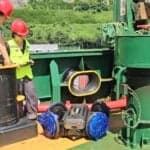


A self-driving robot has completed the world’s first autonomous shipboard demonstration, showing it can operate inside vessel areas where hazardous conditions may make access difficult for crew members.
Hyundai Motor and Kia’s mobile robot platform MobED was tested aboard the multipurpose vessel HYUNDAI DUBAI during a demonstration conducted with Korean Register, HMM, HMM Ocean Service and Goseong Engineering in Changwon, South Korea.
The trial examined whether a land-based autonomous robot could function reliably in a moving ship environment affected by vibration, movement and changing surfaces.
The demonstration focused on using maritime robotics for future smart ship operations, including cargo hold inspections, monitoring and material transport in areas that may contain hazardous conditions.
MobED completed autonomous navigation tasks in the vessel’s cargo area, including straight and curved driving, low-speed and high-speed movement, route learning and autonomous operation.
The robot uses independently controlled wheels designed to maintain stable movement across uneven surfaces, inclines and thresholds. The platform can be equipped with inspection tools, cameras and delivery systems depending on the onboard task.
During testing inside narrow passageways, MobED successfully completed route learning and low-speed operation. However, limited space meant operators switched the robot to remote control rather than allowing fully autonomous navigation in those areas.
The organisations involved said the demonstration showed that autonomous robots could operate in large cargo spaces without requiring modifications to existing ship infrastructure.
Hyundai and Kia developed the MobED platform and control technology, while Korean Register evaluated robot-related safety standards and regulations.
“This demonstration is a prime example of confirming the applicability of autonomous driving technology within a ship environment,” said Park Min-Woo, President of Hyundai and Kia, according to a translated statement.
The trial highlights a possible role for autonomous robots in supporting seafarer safety during cargo hold inspections and operations in hazardous ship environments.
Cargo areas containing explosive or toxic materials can create situations where reducing crew exposure may improve operational safety.
Ships often require inspections and monitoring in enclosed spaces where access can involve additional risks. The tested robot could support these activities by entering areas that may be difficult or unsafe for direct crew access while carrying cameras or inspection equipment.
However, the technology remains at a demonstration stage, with further development needed before wider onboard applications can be considered.
The project partners identified confined areas such as engine rooms and narrow corridors as challenges that may require additional sensors or smaller robotic platforms.
Korean Register said future work will focus on establishing safety and performance standards for onboard robot applications and conducting further demonstrations.
The partners will continue examining how robots can be used for tasks such as cargo area watchkeeping and material transport as part of future smart ship operations.
Source: shippingmatters, smartmaritimenetwork
Want to read more?
Check out the full article on the original site