The World’s Largest Methanol Bunkering Ship Just Fuelled A Brand New Car Carrier In Shanghai
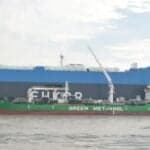


The 9,300-CEU M/V Arctic Tern received 2,800 metric tonnes of green methanol in China’s largest simultaneous car-handling and bunkering operation.
EUKOR Car Carriers, SIPG Energy, and World Fuel Services have completed the first green methanol bunkering involving the new car carrier at the Port of Shanghai.
M/V Arctic Tern is the flagship of Wallenius Wilhelmsen’s Shaper Class fleet renewal program, which consists of 14 vessels. It received the sustainable fuel via a ship-to-ship transfer at Haitong Terminal. The operation was conducted by SIPG Energy’s M/V Hai Gang Zhi Yuan, the world’s largest methanol bunkering vessel.
“Completing Arctic Tern’s first green methanol bunkering shortly after delivery is a significant milestone,” said Xavier Leroi, COO Shipping Services at Wallenius Wilhelmsen and CEO of EUKOR.
“It demonstrates how investments in next-generation vessel technology and fuel flexibility are being translated into real-world operations.”
The refuelling was conducted under Simultaneous Operations (SIMOPs), with ro-ro cargo handling taking place while the fuel transfer was underway.
It was China’s largest single SIMOPs green methanol bunkering for a PCTC and proved that alternative fuels could be integrated into tight port calls without causing delays in vessel turnaround. The green methanol was produced in Shanghai itself, from municipal solid waste. It was certified by ISCC-EU and had a carbon intensity below 25 gCO₂e/MJ.
The Arctic Tern was constructed at China Merchants Jinling Shipyard in Nanjing under the oversight of Wallenius Marine and is currently managed by Wilhelmsen Ship Management.
It is designed to sail on the East Asia-to-Europe trade. For EUKOR, which is jointly owned by Wallenius Wilhelmsen and Hyundai Motor Group, using an ultra-low carbon fuel on the Europe route would reduce compliance costs under the EU ETS and FuelEU.
The EU ETS (Emissions Trading System) and FuelEU Maritime are two different European Union regulations which were designed to decarbonise the shipping industry.
While the EU ETS acts as a financial penalty on the total amount of emissions produced, FuelEU Maritime acts as a technical mandate that restricts the carbon intensity of the fuel itself.
World Fuel arranged the operation, while SIPG Energy acted as the supplier. SIPG Energy General Manager Zhang Da noted that expanding STS methanol bunkering from container ships to PCTCs positions Shanghai as Asia’s premier green energy hub.
Arctic Tern is named after the seabird which makes the longest annual migration in the world. It is a pure car and truck carrier equipped with an advanced hull air lubrication system, solar panels, shore power connections, battery packs and much more.
It is designed in such a way that it can be easily converted to run on zero-emissions ammonia fuel as supply chains for the fuel mature in future. The vessel would be followed by 13 sister ships, including 8 ‘Shaper+’ mega-carriers with a record-setting capacity of 12, 100 CEU.
In order to safely handle the increasing exports of battery-electric vehicles from China, Arctic Tern is also fitted with an upgraded voluntary fire suppression system capable of isolating two different fire zones in the cargo hold.
Want to read more?
Check out the full article on the original site