Pilot’s Cellphone Distraction Leads To Fatal Houston Ship Channel Collision Involving Bulk Carrier And Towboat – NTSB
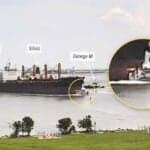


A Houston ship pilot’s use of a personal cellphone and failures to maintain a proper lookout by multiple crew members led to a fatal collision between a bulk carrier and a towing vessel in Texas in 2024, the U.S. National Transportation Safety Board (NTSB) said.
The collision between the bulk carrier Yangze 7 and the towing vessel Miss Peggy occurred on July 19, 2024, in the Houston Ship Channel near Lynchburg, Texas. The impact caused the Miss Peggy to capsize and sink with five crewmembers onboard.
Four crew members were rescued by the tugboat George M, while the fifth crewmember was later found dead inside the wreckage.
One survivor suffered serious injuries and another sustained minor injuries. The NTSB estimated that salvage operations and pollution cleanup cost about $3.7 million. The Yangze 7 was not damaged.
The NTSB said the collision happened after the pilot directing the Yangze 7 lost awareness of the Miss Peggy’s location while engaged in a 39-minute personal phone call that was unrelated to vessel operations.
Investigators also found that both vessels failed to maintain a proper lookout before the accident.
Pilot was on personal call before collision
The accident happened shortly after 2 p.m. as both vessels were travelling inbound on the Houston Ship Channel.
The Yangze 7 was heading to Kinder Morgan’s bulk terminal in Houston to load coal, while the Miss Peggy was travelling lightboat toward its home fleet at Houston Fleeting Services in Channelview, Texas.
The NTSB found that the Houston pilot aboard the Yangze 7 answered a call at 1:22 p.m. from another pilot who was aboard the tanker Petrel, which was travelling outbound on the same waterway.
The call continued for 39 minutes and ended two minutes and 16 seconds before the collision.
According to the NTSB investigation, the pilot continued the phone conversation while giving rudder and heading instructions to the Yangze 7.
The second officer aboard the bulk carrier told investigators that he was “very afraid” because the pilot was using an earpiece while talking and issuing steering orders.
The officer said the conversation was not related to the vessel, safety or navigation and that he was concerned the pilot could give an incorrect order.
The NTSB said using a cellphone can be distracting because it can take a person’s attention away from their main task.
Vessels failed to detect each other
The investigation found that both vessels failed to maintain a proper lookout.
The captain of the Miss Peggy did not notice the Yangze 7 approaching from astern, while the Yangze 7 bridge team did not detect the towboat until it was less than a ship’s length away.
Before the collision, the Yangze 7 approached the Crossover area of the Houston Ship Channel, where the pilot communicated with Vessel Traffic Service (VTS) Houston-Galveston.
The VTS operator informed the pilot about two downbound vessels, the Silvio and the Eagle Hamilton.
The Yangze 7 pilot then made passing arrangements with the Silvio’s pilot. At the same time, the tugboat George M was following behind the Silvio.
The George M crew noticed that the Yangze 7 was closing on the Miss Peggy and issued a radio warning.
Despite the warning, and despite a Yangze 7 bosun reporting a vessel about 20 to 30 metres ahead, the pilot did not see the Miss Peggy before the collision.
At 2:03 p.m., the Yangze 7’s bulbous bow struck the stern of the Miss Peggy, causing the towboat to roll to starboard and capsize.
About 30 seconds later, the George M crew informed the Yangze 7 that it had hit a towboat and overturned it.
Four crew members rescued
After the collision, the George M crew deployed the vessel’s Dacon rescue frame and moved into position to rescue people from the water.
The Miss Peggy captain, who was inside the wheelhouse when the vessel overturned, escaped through a window and reached the surface.
According to the NTSB report, the captain saw one deckhand in the water as the Yangze 7 passed by and told investigators that this was the first time he noticed the bulk carrier.
Two crew members who were inside the galley during the collision were also affected. The lead deckhand lost consciousness but later reached the surface through an open door. Another deckhand did not survive.
An off-watch lead deckhand escaped from his stateroom after the vessel capsized and reached the surface through an exterior door.
The body of Aquarius Lowman, the deckhand who died in the accident, was recovered a few days later after the Miss Peggy was salvaged.
NTSB recommends restrictions on cellphone use
Following the investigation, the NTSB issued two safety recommendations.
The agency recommended that the U.S. Coast Guard prohibit non-operational use of personal electronic devices by people directing vessel movements on waterways under its authority.
It also recommended that the American Pilots’ Association develop guidance preventing pilots from using personal electronic devices for non-operational purposes while actively directing vessels and encourage member associations to adopt similar rules.
Reference: NTSB
Want to read more?
Check out the full article on the original site