US Warship 3D-Prints 1,000 Parts And 12 Flight Ready Drones In Just 2 Weeks At Sea
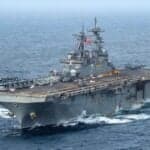


A US defence technology company has produced more than 1,000 parts and assembled 12 drones aboard a US Navy warship during a two-week trial.
Firestorm Labs carried out the demonstration aboard the USS Essex as the Wasp-class amphibious assault ship travelled from San Diego to Hawaii for RIMPAC 2026.
The company used its containerised xCell manufacturing platform to produce drone components, repair parts and other equipment while the ship was operating in the Pacific.
The trial was aimed at reducing dependence on shore-based supply chains by allowing crews to make required parts closer to where they are needed.
Manufacturing parts at sea
The deployment was the first maritime demonstration of Firestorm’s xCell platform under operational conditions.
During the trial, the system continued operating as the USS Essex faced waves of up to 12 feet. Firestorm said production continued in sea state 5 conditions, despite the movement of the vessel.
The company produced three categories of hardware during the deployment:
- Mechanical test pieces to check printer performance
- Components for Squall first-person-view drones
- Repair items requested by the ship’s crew
More than 20 crew-requested items were manufactured during the voyage. These included deck tie-down inspection gauges, reverse-engineered valve handwheels, electrical covers, cable hardware, door components, a Starlink deployment mount and a nonconductive digging knife for explosive ordnance disposal teams.
Drones assembled during voyage
Firestorm assembled 12 Squall FPV drones aboard the USS Essex during its journey to Hawaii.
The drones were later used during RIMPAC 2026, where soldiers, sailors and Marines received training in additive manufacturing, drone assembly and flight operations.
Marines from the 3rd Light Armored Reconnaissance Battalion operated the drones as adversary aircraft during a three-day counter-unmanned aircraft systems exercise at Makua Military Reservation on Oahu.
The flights supported experimentation conducted through the Naval Postgraduate School’s CAMRE network.
Apache rotor guard droop stop
One of the parts produced during the trial was an Apache rotor guard droop stop, designed during the first Army-Navy Apache operations conducted at sea.
The component was intended to reduce the risk of the helicopter’s rotor striking the deck while the ship was moving through heavy seas.
Firestorm said an Apache main rotor costs about $500,000, while damage caused by a blade striking the deck could cost $230,000 for each of its four blades.
The company also developed a vacuum adapter for inflatable Life Preserving Units after a sailor suggested the requirement. Firestorm created three versions of the connector for different vacuum systems and operating needs.
Navy explores mobile defence manufacturing
Firestorm developed the xCell system as a containerised manufacturing unit that can produce unmanned aerial systems and spare parts for expeditionary operations.
The US Navy has been exploring containerised defence capabilities that can be transported and deployed in different regions.
Chief of Naval Operations Adm. Daryl Caudle announced the Navy’s “containerized capability campaign plan” in March at the McAleese Defense Programs conference. The plan described a vision for transportable containers carrying defence capabilities, including drones and weapons.
In May, the Pentagon announced framework agreements with defence companies Anduril, CoAspire, Leidos and Zone 5 to acquire more than 10,000 containerised missiles over three years beginning in 2027 under the Low-Cost Containerised Munitions (LCCM) programme.
Future use of at-sea manufacturing
Firestorm said producing parts aboard ships could reduce the need to transport equipment across long distances and help crews complete repairs without waiting for traditional resupply.
“Every part xCell printed on deck is one that doesn’t need to be flown or shipped across contested waters – cutting the fuel, aircraft hours, and personnel it takes to keep a ship operational,” the company said.
The USS Essex trial showed that mobile manufacturing systems can produce drones and repair components during a maritime mission. No timeline was disclosed for wider deployment of the technology.
References: interestingengineering, robottoday
Want to read more?
Check out the full article on the original site