Rhine Water Levels Forecast To Drop To Critical Lows, Threatening European Supply Chains
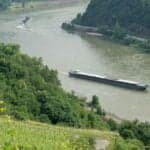


Low water levels could halt shipping operations on a critical stretch of the river Rhine and bisect one of Europe’s most vital waterways into two disconnected zones.
According to Jens Schwanen, managing director of the Federal Association of German Inland Shipping, water levels at the Kaub gauging station, which lies south of Koblenz along a bottleneck on the middle part of the river, could plunge into single digits due to low rainfall this year.
If this happens, barges carrying cargo, excursion vessels, cruise ships and others will not be able to navigate the area, which would severely disrupt river transport between the northern maritime centres and the industrial corridors in the south.
Though shipping would continue in segments, between the ARA ports of Amsterdam, Rotterdam, and Antwerp and the northern German canal network, or along southern tributaries like the Main, Moselle, and Neckar rivers, the Rhine will not be fully navigable.
The economic impact of this would be significant for Western Europe’s industrial supply chains, as the river handles over 80% of Germany’s inland waterway cargo.
Operators would also need to implement certain measures to prevent grounding, such as partially loading their ships to 20-30% of their total payload capacity.
This means that there could be a shortage of goods, or more trips would be required to deliver bulk goods like coal to regional power plants, or chemicals, refined petroleum products, steel, agricultural produce and other products.
Shipping Companies have now started to levy low-water surcharges to offset lost payload capacity, which has led to an increase in spot freight prices across the region.
Although several German state governments, including North Rhine-Westphalia, Lower Saxony, Rhineland-Palatinate, and Saarland, decided to relax the trucking restrictions over the weekend to resolve supply chain issues, all the river cargo cannot be delivered to its destination using land transport, due to its massive volume.
For example, a river barge can carry 2500 tonnes of cargo, whereas the same amount would need atleast least 100 heavy trucks.
Meanwhile, the road and railways are facing labour shortages and congestion and are in no position to handle the extra freight.
Decreasing water levels are affecting shipping on Central Europe’s major river basins. The cause is global warming, which has led to prolonged summer heatwaves, less rainfall, and reduced winter snowpack across the Swiss Alps, which is the river’s main source of water through late summer.
The Danube is also facing a similar problem. To find a lasting solution, Germany’s Federal Ministry of Transport has made engineering plans to deepen the navigational bottleneck near Kaub by roughly twenty centimetres.
However, environmental impact assessments and riverbed engineering would be required, meaning implementation could take years.
Inland shipping companies are investing in modernised fleet designs, introducing specialised low-draft barges featuring broader hulls, lightweight design and advanced water-ballast management systems to operate during low-water events in the river.
Want to read more?
Check out the full article on the original site