Houthis Attack Red Sea Port Of Mokha And Saudi Oil Facility, Killing 7 And Injuring 15
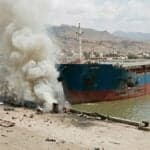


Yemen’s Houthi rebels attacked the government-held port of Mokha on the Red Sea with missiles and drones on Sunday, killing at least seven people and injuring 15 civilians.
The group also said it targeted an Aramco refinery facility in Saudi Arabia with a drone, after which a fire was reported.
The National Resistance Forces, a Yemeni government-allied group, said four troops and three civilians were killed in the attack on Mokha. Fifteen civilians were injured.
Fayed al-Noman, assistant undersecretary at Yemen’s information ministry, said the Houthis used missiles and drones that badly damaged port buildings and piers. Commercial goods and food supplies were also damaged, he said.
The military later said missiles landed in several areas, including near a television channel.
The Houthis claimed responsibility for the attack, saying they had fired a large number of ballistic missiles and drones at military forces and warehouses.
Houthi attack damages Mokha port
Mokha is one of the main ports controlled by Yemen’s internationally recognised government. The port has been renovated to handle shipping that avoids the Houthi-controlled port of Hodeida.
The Houthis said they were targeting Saudi-backed troops and military equipment near the city.
The attack comes more than four years after a 2022 truce brought major fighting in Yemen to an end.
Mokha’s location on the Red Sea also gives the attack significance for maritime security. Yemen lies near the Bab el-Mandeb Strait, an important route connecting the Red Sea with the Gulf of Aden.
Houthi drone strike reported at Saudi oil facility
Houthi military spokesperson Yahya Saree said the group also targeted an Aramco refinery in the Saudi city of Jazan with a drone.
Saree said the attack was carried out in response to Saudi drones allegedly entering Yemen’s airspace over the provinces of Hajjah and Saada.
Saudi Arabia’s Energy Ministry reported a fire at a facility belonging to the Aramco refinery early on Sunday.
The ministry said the fire was extinguished and that there were no casualties. It did not say what caused the fire.
The Houthi attack on the Saudi facility took place on the same day as the missile and drone attack on Mokha.
Mokha has been renovated to handle vessels avoiding Hodeida, which is under Houthi control. Damage to its buildings, pier and cargo could affect the port’s operations, although the supplied information does not give details of any vessel diversions or wider commercial losses following Sunday’s attack.
The Houthis have also sought to control shipping around the Bab el-Mandeb Strait, adding to concerns over the movement of oil and other cargo through the region.
Iran and Oman discuss Strait of Hormuz deal
Iran and Oman worked on a temporary deal that could allow shipping to resume through the Strait of Hormuz.
The strait is an important route for global oil and natural gas supplies.
Under the proposed arrangement, ships would enter the strait through a route close to Iran and leave through a route close to Oman, according to two people familiar with the talks. They spoke on condition of anonymity because they were not authorised to speak publicly.
Ships would not pay fees or tolls during the temporary arrangement.
The deal is intended to restore an earlier, separate agreement between the United States and Iran and restart a 60-day period for talks over Iran’s nuclear programme.
The two people said the proposal has the backing of members of the Gulf Cooperation Council. They said Iran, Oman, the United States and the United Nations’ International Maritime Organization are expected to announce the agreement jointly if it is finalised.
The terms could still change before a final deal is reached.
Iran signalled progress on Sunday, but Foreign Minister Abbas Araghchi said talks with Oman over “new maritime routes” were in their final stages and stressed that this did not mean the Strait of Hormuz would reopen.
He said an agreement on the routes could be reached, but reopening the strait would depend on other conditions that had been conveyed through intermediaries.
Iran’s Supreme National Security Council said on Saturday that the strait would not reopen until the United States “corrects its behavior”.
Iran has demanded that the United States stop threatening Iran, permanently end the war with Iran and its armed allies, lift the naval blockade of Iranian ports and withdraw U.S. forces from the region.
Tehran has also demanded compensation for war damage, the lifting of sanctions and the unconditional release of frozen assets.
Araghchi said messages were still being exchanged between Iran and the United States through intermediaries, but said this did not amount to negotiations.
He said talks could not resume until violations of the countries’ memorandum of understanding had ended and the United States had addressed provisions it had violated.
Iran considers restrictions on some vessels
Iran’s parliament National Security Committee has approved the “general outlines” of a plan for managing the Strait of Hormuz, state broadcaster reported.
A member of parliament’s presiding board said countries that had “caused damage” to Iran would not be allowed to transit until they compensated Iran.
Iranian semiofficial outlets Fars and Tasnim reported that the plan was still under expert review. They cited the lawmaker as saying the United States and Israel were among the countries considered “hostile”.
There were no further details on how the proposed restrictions would be implemented.
U.S. says 53 commercial vessels redirected
The U.S. Central Command said its blockade had redirected 53 commercial vessels, disabled two and boarded two through Saturday.
At the same time, the Pentagon is pushing for faster weapons production as the U.S. military faces concerns over its stockpiles.
Pentagon spokesman Sean Parnell said on Saturday that the department was focused on increasing munitions purchases to provide weapons to U.S. forces at the pace required by the threat.
A new analysis from the Center for Strategic and International Studies said the war with Iran had further reduced the U.S. military’s already limited stockpiles of advanced missile interceptors.
The shortage has raised concerns among allies such as Ukraine and Taiwan, which are seeking more U.S. military support.
Parnell said the effort to speed up weapons production was part of a wider modernisation programme that began before the war that started with U.S. and Israeli attacks on Feb. 28.
Netanyahu rejects Gaza withdrawal before Hamas disarmament
The regional tensions are also continuing alongside the war in Gaza.
Israeli Prime Minister Benjamin Netanyahu said Israel’s military would not withdraw from Gaza until Hamas was “genuinely disarmed”.
Netanyahu told a cabinet meeting that Israel was still discussing Gaza plans with the United States. He said some of the U.S. proposals were acceptable to Israel while others were not.
U.S. President Donald Trump had said Israeli forces would withdraw from Gaza as Hamas completed its disarmament. Israeli forces control more than half of the enclave, according to the supplied information.
Bassem Naim, a member of Hamas’ political bureau, said Hamas remained committed to the roadmap and expected mediators and the United States to pressure Netanyahu.
The Hamas-led attack on Israel on Oct. 7, 2023, triggered the war in Gaza. A fragile ceasefire remains in place.
References: NYPost, Fortune
Want to read more?
Check out the full article on the original site