US Deploys More Than 20 Warships Across Middle East To Enforce Iran Naval Blockade
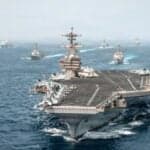


The United States has deployed more than 20 warships to the Middle East as it enforces a blockade against Iran, while U.S. forces have redirected 55 commercial vessels, U.S. Central Command (CENTCOM) said.
CENTCOM said on Aug. 9 that its forces had redirected 55 commercial vessels, disabled two and boarded two to enforce the blockade. The USS Ross, a U.S. Navy destroyer, is among the warships deployed to the region.
Tensions remain high around the Strait of Hormuz, a key route for global oil and natural gas shipments. Iran has said it will not reopen the waterway to commercial shipping unless the United States meets several demands.
At the same time, Iran says talks with Oman on new shipping lanes through the Strait of Hormuz are in their final stages.
CENTCOM said the warships are supporting military missions, including what it called the “strict enforcement” of the U.S. blockade against Iran.
The U.S. military has continued to restrict Iranian shipping since Washington reimposed its blockade in the Gulf in July. Iran said the move violated a ceasefire agreed with the United States in June, which had already broken down.
Tehran has linked the reopening of the Strait of Hormuz to the lifting of the blockade and sanctions, as well as an end to U.S. military threats.
Mohammad Baqer Zolqadr, secretary of Iran’s top national security body, has also called for an end to further U.S. threats against Iran, a halt to attacks against Iran and its regional allies, the removal of the naval blockade, sanctions relief and the release of frozen Iranian assets.
Why the Strait of Hormuz matters
The Strait of Hormuz connects the Persian Gulf with the Gulf of Oman and the Arabian Sea. It is one of the world’s main routes for oil and natural gas shipments.
About one-fifth of global crude and natural gas shipments pass through the waterway in peacetime. Continued disruption could therefore affect commercial shipping and energy markets.
Iran’s Revolutionary Guard Corps has previously targeted ships that it said tried to cross the strait without Iranian permission.
Further south, Yemen-based Houthi forces have continued attacks around the Bab el-Mandeb, another important maritime route connecting the Red Sea and the Gulf of Aden.
The United Arab Emirates has also said that Iran attacked a ship linked to its state oil company.
The Houthis said they attacked Saudi Aramco’s Jazan refinery. Saudi Arabia’s energy ministry confirmed that a fire broke out at the refinery but said it was put out and there were no injuries.
Iran and Oman work on new shipping lanes
While the U.S. military continues its operations, Iran says it is close to an agreement with Oman on new shipping lanes through the Strait of Hormuz.
Iranian Foreign Minister Abbas Araqchi said on Sunday that the agreement was in its “final stages”.
The proposed arrangement would provide new routes that could be used once the conditions for reopening the strait are met. It would not, by itself, reopen the waterway.
Iran has continued to say that the strait will only reopen after Washington meets its demands.
Araqchi said Iran and the United States are not holding direct talks. Messages between the two countries are being passed through intermediaries, he said.
A U.S. official told Reuters that Washington would lift its blockade of Iranian ports under an agreement aimed at restoring commercial shipping without impediments. The official said U.S. actions would depend on Iran carrying out its commitments.
Trump describes talks as ‘low-key’
U.S. President Donald Trump has said Washington is keeping its engagement with Iran limited.
Speaking to Axios, Trump said the United States was “low-keying” its engagement with Iran and was only “semi-negotiating” with Tehran.
“We are just watching Iran with its huge inflation and the fact they have no money,” Trump said, according to Axios.
Iranian officials have continued to say that there are no direct negotiations between Tehran and Washington.
The developments follow U.S. and Israeli air strikes on Iran more than five months ago. Washington said the strikes were aimed at preventing Iran from developing nuclear weapons and reducing its ability to threaten the region.
A ceasefire between Washington and Tehran was agreed in June, followed by the U.S. blockade on Iranian shipping in the Gulf in July. Tehran said the blockade violated the truce.
References: news18, moneycontrol
Want to read more?
Check out the full article on the original site