U.S. Navy Witnesses First Ever Submerged Payload Launch From An Autonomous Undersea Vehicle
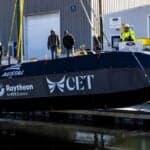


Raytheon and Composite Energy Technologies (CET) recently demonstrated a submerged payload launch for the HADALUS unmanned undersea vehicle (UUV) during a U.S. Navy exercise at an undersea test range.
This was the first time that the U.S Navy witnessed a payload launch from a vehicle entirely underwater, solving a major issue in long-endurance autonomous operations.
The 34-foot-long platform, with a 6-foot cross-section, is built for long-range missions with an operational endurance exceeding 2,000 nautical miles.
Rather than using a fully sealed conventional hull, CET constructed HADALUS around a free-flooded carbon-fibre exoskeleton that allows seawater to flow through portions of the structure.
This kind of design reduces weight, lowers manufacturing demands, and allows a large number of sensors, weapons, and electronics to be installed onboard, given the massive internal volume.
However, according to the companies, the launch was not easy, as it required overcoming several hurdles.
The undersea vehicle had to achieve perfect stability and also deploy the payloads without depending on surface support ships or exposing its position underwater to prevent being detected.
HANDALUS integrates Raytheon’s sonar and command electronics made for special long-endurance operations and also CET’s composite design. This allows the UUV to combine different phases of a mission like detecting enemy targets, reacquisition, and engagement into a single deployment.
The platform is also cost-effective, and both Raytheon and CET estimate it would cost between one-third to one-fifth as much as comparable long-endurance UUVs.
This is in sync with the Navy’s strategy to develop and acquire low-cost, high-return AI and Autonomous Tech, which is scalable without placing a burden on crewed ships of the fleet.
According to the sources, the team arranged the trial in 18 months, after moving from concept design to complete integration.
Though additional trials will be required before the HANDALUS can attain full combat readiness, the demonstration was extremely important as it showed that low-cost, deep-water autonomous capabilities can be used in a high-stakes naval mission.
Want to read more?
Check out the full article on the original site