Poland Rolls Out First New-Generation Frigate Under $3.5 Billion Naval Modernisation Plan
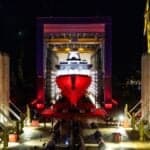


Poland has started the launch process for its first new-generation multi-role frigate, ORP Wicher, as part of a PLN 15 billion ($3.49 billion) programme to modernise its navy.
The hull of Wicher was moved partly out of its construction hall at the PGZ Stocznia Wojenna shipyard in Gdynia on Sunday.
The ship is due to be formally named and christened on Wednesday before being launched into the Gulf of Gdańsk on Thursday.
The unfinished frigate will return to the shipyard after the launch for further equipment installation, testing and other work.
Wicher is the first of three frigates being built under Poland’s Miecznik, or “Swordsman”, programme, the country’s largest naval modernisation project.
The ships are intended to replace Poland’s ageing Oliver Hazard Perry-class frigates and become the main combat vessels of its navy.
The programme is also aimed at giving Poland new ships for air defence, anti-ship and anti-submarine missions, as well as the protection of shipping routes and maritime infrastructure. The frigates will be able to operate with NATO forces.
Taki widok nie zdarza się często.
Wczoraj wieczorem wyprowadziliśmy kadłub fregaty #Wicher z Hali Kadłubowej i podświetliliśmy go po zmierzchu. Złożyliśmy dla Was najlepsze kadry tego wieczoru w jedną rolkę.
A prawdziwe emocje dopiero przed nami – chrzest i wodowanie pierwszej… pic.twitter.com/Luj9MufLjh— PGZ Stocznia Wojenna
(@StoczniaWojenna) August 10, 2026
Three frigates under construction
Two other ships, ORP Burza and ORP Huragan, are also being built under the programme.
The Miecznik frigates are based on Britain’s Arrowhead 140 design, adapted for Polish military requirements. The design is owned by British defence company Babcock, which is working with the Polish-led PGZ Miecznik consortium.
The ships will be about 138-140 metres long and have a displacement of around 7,000 tonnes when fully equipped.
They are expected to carry Mk 41 vertical launch systems, CAMM and CAMM-ER air-defence missiles, anti-ship missiles, naval guns and torpedoes.
The frigates are designed mainly for air defence but will also be used for anti-ship and anti-submarine operations. Their guns will have a range of up to 40 km, while their anti-ship missiles will be able to hit targets more than 200 km away.
The ships will also be used to protect shipping lanes and maritime infrastructure and are designed to operate with NATO’s Standing Naval Forces.

Complex operation at Gdynia shipyard
The rollout of Wicher involved specialised self-propelled modular transporter (SPMT) systems.
According to Polska Grupa Zbrojeniowa, the hull currently weighs about 3,170 tonnes. The company said the hull was moved partly out of the construction hall and prepared for the next stage of transport.
Shipyard officials said moving the vessel and lowering it into the water using a semi-submersible barge will be one of the most demanding engineering operations in Polish shipbuilding history.
The launch will move Wicher into the next phase of the programme, with further outfitting, equipment installation, systems integration and testing still required.
Programme cost rises to PLN 15 billion
Poland’s Armaments Agency signed the original construction contract with the PGZ Miecznik consortium in 2021 for PLN 8 billion ($1.86 billion).
The value of the programme rose to PLN 15 billion ($3.49 billion) by late 2023 after contract amendments.
The Polish consortium includes Polska Grupa Zbrojeniowa, PGZ Stocznia Wojenna and Remontowa Shipbuilding. International technology partners include Babcock, Thales and MBDA.
The programme is intended to deliver the three frigates while also strengthening Poland’s domestic naval shipbuilding and systems-integration capabilities.
Kadłub pierwszej z trzech fregat programu „Miecznik” częściowo opuścił halę kadłubową i zatrzymał się przed nabrzeżem. W @PGZ_pl Stoczni Wojennej trwa wielodniowa operacja, której finałem będzie wodowanie przyszłego ORP „Wicher”.@MarWojRP @MON_GOV_PL pic.twitter.com/K2YLgIZnjT
— Gdynia (@MiastoGdynia) August 10, 2026
Replacing older frigates
The Miecznik ships are intended to replace Poland’s Cold War-era Oliver Hazard Perry-class frigates.
Two of the current vessels, ORP Gen. T. Kościuszko and ORP Gen. K. Pułaski, entered service with the U.S. Navy in 1980 before being transferred to Poland in the early 2000s.
Wicher is expected to enter Polish Navy service in 2029. The final frigate is expected to enter service around 2031-2032, with the overall programme scheduled for completion by the end of 2031.
Name linked to Poland’s naval history
The name Wicher, which means “gale” in Polish, was also used by a pre-war Polish destroyer.
The original Wicher defended the Polish coast during the German invasion in 1939 and was sunk by German aircraft off the Hel Peninsula on Sept. 3, 1939.
The new Wicher is now approaching its formal christening and launch, after which it will return to the shipyard for further work before testing and eventual entry into Polish Navy service.
References: defensehere, polskieradio
Want to read more?
Check out the full article on the original site