China Set To Launch Arctic ‘Ice Silk Road’ To Bypass Increasingly Vulnerable Maritime Chokepoints
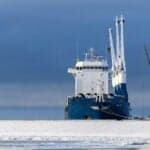


China is preparing to launch its first regular container shipping service through the Arctic this week, giving ships travelling between Asia and Europe another route at a time when security concerns continue to affect major maritime chokepoints.
Chinese shipping company Sea Legend will operate the weekly service between Ningbo, China, and Felixstowe in the United Kingdom. The route will pass through Russia’s Northern Sea Route (NSR), along the country’s Arctic coast.
Sea Legend has named the service the “Ice Silk Road”. Its official name is the China-Europe Arctic Express.
The Arctic route can reduce the usual sailing time between Ningbo and Felixstowe from about 40 days to roughly 20 days, depending on conditions. It also allows ships to avoid routes such as the Bab al-Mandab Strait and the Red Sea.
“There’s been a definite increase in traffic through the Arctic and Northern Sea Route,” said Rahul Khanna, global head of marine risk consulting at insurer Allianz.
He said shipowners were looking at the route because it could save time and cost and allow them to avoid geopolitical chokepoints and conflict zones.
Sea Legend Begins Regular Arctic Service
The new service follows Sea Legend’s trial voyage through the Northern Sea Route in September 2025. The company said that voyage set a new speed record between China and Northern Europe.
The first vessel for the new service is the Dubai Tower, a Liberia-registered containership built in 2010.
The vessel has a deadweight of 23,338 tonnes and can carry 1,740 TEUs. It is scheduled to reach Zhoushan on Aug. 11 to begin loading containers and is due to leave on Aug. 15.
Dubai Tower is expected to reach Felixstowe in 20 days.
Sea Legend plans to run the service weekly. Its final departure is scheduled for Oct. 3, with the last arrival in Felixstowe planned for Oct. 24.
The company manages 17 vessels and has reportedly received licences for seven vessels to operate on the Northern Sea Route this year.
One of them is Istanbul Bridge, a vessel with a deadweight of 66,781 tonnes that completed a Northern Sea Route voyage in 2025.
Sea Legend also operates more traditional services through the Suez Canal to the Middle East and Africa and focuses on markets in Turkey and North Africa.
More Ships Using Northern Sea Route
Interest in the Northern Sea Route has increased in recent years.
There were 23 containership transits through the route in 2025, compared with 15 in 2024, according to data cited by the Financial Times.
Most earlier voyages were one-off trips or demonstrations rather than scheduled services.
Russia’s state-controlled Rosatom said it had completed issuing permits for the 2026 season. The season is scheduled to continue until November.
The Northern Sea Route is divided into 28 sections, with different rules depending on ice conditions. Ships need permits to use the route and can receive assistance from Russian icebreakers.
Declining Arctic sea ice has also made the route easier to use during parts of the year.
Researchers at the University of Southampton found that Arctic sea ice during the peak winter period fell by 5.8% between 2024 and 2025. The decline was described as the biggest on record in the research cited by the Financial Times.
Sea ice recovered slightly this year but remained at its second-lowest level on record.
During the summer, melting ice can allow ships to use parts of the route without icebreaker capabilities.
Commercial vessels continue to face security concerns around traditional routes.
Houthi militants said on July 23 that they had attacked two Saudi Arabian tankers in the Red Sea. The attacks sent oil prices back above $100 a barrel, according to the source material.
The Bab al-Mandab Strait, which connects the Red Sea with the Gulf of Aden, has also remained a concern for shipping companies because of security threats in the area.
Using the Northern Sea Route allows ships travelling between Asia and Europe to avoid the Bab al-Mandab and Red Sea.
Khanna said enquiries about using the Northern Sea Route had increased over the past five years.
But the Arctic route comes with its own risks.
“There is always the risk of oil spill or pollution and you are far from search and rescue,” said Malte Humpert, an Arctic shipping expert at High North News.
Humpert also said the shorter route could help reduce CO2 emissions.
Arctic Shipping Brings New Risks
Operating in the Arctic is more difficult than sailing on established commercial routes.
Ships have to deal with ice fields, and GPS can sometimes fail in the far north. Emergency services are also limited, making accidents more difficult to manage.
Allianz analysis found more than 500 reported shipping incidents in the Arctic Circle over the past 10 years. Machinery damage or failure was responsible for almost half of those incidents.
Khanna said ships could become stuck if icebreaker support was not available.
A serious accident could also be difficult to handle because of limited salvage, firefighting, assistance and rescue facilities in the region.
Ships operating in the Arctic must comply with the International Maritime Organization’s Polar Code, which sets safety and environmental standards for vessels in polar waters.
Arctic Becomes Area of Geopolitical Competition
The increase in commercial shipping is also taking place as Russia, China and the United States compete over the Arctic.
Russia considers its Arctic territory an important economic lifeline. China describes itself as a “near-Arctic state” and has promoted the idea of a “Polar Silk Road”.
The United States has opposed what it sees as a monopoly by Sino-Russian states and has supported freedom of navigation.
European shipping companies have largely avoided the Northern Sea Route because of concerns about relations with Russia and the environmental impact of shipping in the Arctic.
Maersk sent a container ship through the route between Vladivostok and St Petersburg in 2018. The Danish company and several other European shipping lines later pledged not to use the route.
At the same time, interest in vessels capable of operating in icy conditions has increased.
Maritime data company Veson Nautical said 167 ice-class vessels were built last year, the highest number in more than a decade. Another 164 are due to be built this year.
Environmental Concerns Over Arctic Shipping
The increase in Arctic shipping has faced opposition from environmental groups.
Norwegian NGO Bellona Foundation last year criticised the transit of Istanbul Bridge and other commercial shipping on the Northern Sea Route. It described the activity as “completely unacceptable” and raised concerns about the vessel’s age and its use of heavy fuel oil.
Former Canadian environment minister Steven Guilbeault, who is sailing across the Arctic to raise awareness about issues affecting the region, said climate change was having a major impact on the Arctic.
He warned that increased shipping by vessels from outside Arctic nations could also increase security risks in the region.
China and South Korea Expand Arctic Interest
Sea Legend is not the only Chinese company using the Northern Sea Route.
China’s Yangpu Newnew Shipping has also operated vessels there. Its vessel Newnew Polar Bear was involved in a 2023 incident in which it was charged with severing Finland’s undersea cables.
The China Shipowners’ Association has also said dry bulk vessels will operate on the route this season, with calls planned at Murmansk and Arkhangelsk in Russia.
South Korea is also preparing its first demonstration voyage through the Northern Sea Route later this month.
The voyage will be operated by PanStar and supported by the South Korean government and shipping industry.
South Korea says it will follow international regulations and aims to develop a more compliant and sustainable option for shippers.
PanStar plans to collect data during the 2026 voyage before considering a regular Northern Sea Route service in the coming years.
References: FT, The News
Want to read more?
Check out the full article on the original site