World’s Largest Naval Exercise Displayed The First Drone Boat Resupply Of A U.S Warship
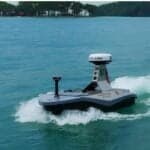


American startup Splash Industries executed the world’s first fully autonomous underway resupply of a U.S Navy warship using an Unmanned Surface Vehicle, the Tyhoon, developed by the company itself.
The demonstration took place off the coast of Hawaii during the Rim of the Pacific (RIMPAC) 2026 exercise, the world’s largest international maritime warfare exercise.
During the exercise, the 11-foot Typhoon drone boat navigated sea swells to approach the moving Wasp-class amphibious assault ship USS Essex (LHD-2).
It then guided itself into the vessel’s flooded well deck without a single human command or intervention. The breakthrough feat was captured in video footage which has been released by Splash Industries CEO Ivan Avanesov.
It shows the vessel maintaining its path while it moved forward through the heavy wake created by the warship. It then smoothly entered the well deck while personnel observed the operation from above.
Navigating in ocean waters to dock inside a moving warship is one of the most challenging feats to achieve given the wake pattern, natural ocean swells, changing sea state and many more factors which need to be taken into consideration.
This requires the USV to make split-second decisions depending on the changing situation in real-time.
The Typhoon USV accomplished this complex manoeuvre due to the presence of advanced sensor fusion and autonomous control algorithms.
It operated without any satellite or radio control oversight by evaluating the motion of the USS Essex and adjusting its path in real-time depending on the sea state. It also adjusted its speed and throttle to match the warship.
Typhoon USV is designed for challenging defence missions and environments. It is a high-speed jet boat which can exceed 50 knots, recording speeds beyond 70 knots in trials.
It has an operational range of over 600 nautical miles, extended loitering capabilities, and a modular deck design to carry specialised cargo or sensor payloads.
In another demonstration during the exercise, a Typhoon USV navigated rough seas to autonomously meet up with a U.S Navy aircraft carrier, which was over 100 miles offshore, evidence of its endurance and flexibility.
The docking operation was conducted as part of the Naval Postgraduate School’s Consortium for Additive Manufacturing Research and Education (CAMRE) and FLEETWERX initiatives.
These programs focus on advancing manufacturing, logistics and autonomous supply chains for the U.S Armed Forces.
The USS Essex delivered essential cargo, raw materials and spare components for 3D printers operated by defence partner Firestorm Labs.
The drone boat brought the components to the warship on which drones and other parts were being manufactured. This has far-reaching implications for the U.S Navy and its allies.
Traditional underway replenishment operations depend on supply ships or helicopters to deliver the cargo, which can be difficult given certain conditions, like rough weather, supply chain issues, etc.
Additionally, in contested environments with enemy radar, anti-ship missiles, and electronic warfare that threaten supply vessels, slowing down or bringing a ship to port creates difficulties.
Small, low-cost autonomous surface vessels can easily help in such a situation by transferring critical supplies to warships while they remain at speed.
USVs also reduce operational risks, eliminate the need to put crew members’ lives in danger and lower operational costs compared to traditional transfers.
RIMPAC 2026 demonstrated seamless integration of unmanned systems across multinational task forces.
Unmanned surface vehicles are no longer confined to experimental intelligence, surveillance, and reconnaissance roles; they are now proving their worth in the open ocean.
Want to read more?
Check out the full article on the original site