US Navy Helicopter Fires Hellfire Missiles At Panama-Flagged Ship Attempting To Reach Iran
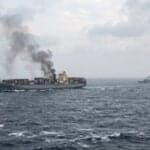


A U.S. Navy helicopter fired two Hellfire missiles at a Panama-flagged cargo ship in the Gulf of Oman after its crew ignored repeated warnings and tried to sail towards an Iranian port, the U.S. Central Command (CENTCOM) said on Tuesday.
The missiles hit the engine room of the M/V Vela Nova and disabled its steering gear, stopping the vessel from continuing towards Iran, according to CENTCOM.
The ship is the third vessel U.S. forces have disabled since Washington brought back its blockade of Iranian ports on July 14.
US says crew ignored repeated warnings
CENTCOM said the Vela Nova was travelling through the Gulf of Oman towards an Iranian port when U.S. forces issued repeated warnings to its civilian crew.
After the warnings were ignored, a U.S. Navy MH-60 helicopter fired two Hellfire missiles into the ship’s engine room.
CENTCOM said the attack disabled the vessel’s steering gear and stopped it from continuing towards Iran.
“The ship is no longer transiting to Iran in violation of the U.S. blockade,” the command said in a statement posted on X.
CENTCOM did not name the Iranian port the vessel was allegedly heading towards.
There were no immediate reports of casualties or injuries.
The Wall Street Journal, citing a U.S. official, reported that the ship appeared to be trying to transfer its crew to another civilian vessel after the attack.
British maritime risk management group Vanguard and a maritime security source also identified the vessel as the Vela Nova.
Earlier assessments had suggested that the ship may have been hit by a missile while sailing through the Gulf of Oman.
Iran had not commented on the incident.
55 commercial ships redirected
The Vela Nova is the third vessel U.S. forces have disabled since the latest blockade began on July 14, according to CENTCOM.
As of Aug. 11, U.S. forces had redirected 55 commercial vessels that attempted to bypass the blockade. They had also disabled three vessels and boarded two others, the military said.
The United States previously enforced a blockade of Iranian ports from April 13 to June 18.
During that period, CENTCOM said its forces disabled nine vessels and redirected more than 140 ships that attempted to get around the restrictions.
Strait of Hormuz remains under pressure
Shipping through the Strait of Hormuz has fallen sharply during the U.S.-Iran conflict.
Iran has said that ending the U.S. blockade of its ports is one of its conditions for reopening the Strait of Hormuz.
Before the war, the waterway was an important route for global oil and liquefied natural gas shipments. Iranian attacks on vessels in the area have since affected shipping through the strait, while energy prices have fluctuated.
The strait is a key route between the Gulf and international shipping lanes, making developments around it important for commercial shipping and energy markets.
Mediators have so far failed to reach an agreement on reopening the waterway. The United States and Iran have continued to exchange fire intermittently since the latest ceasefire collapsed in June.
More than 15 US warships in Arabian Sea
The United States currently has more than 15 warships deployed in the Arabian Sea, including two aircraft carriers and an amphibious assault ship.
The deployment comes as Washington continues its blockade of Iranian ports and maintains military pressure on Tehran.
CENTCOM said U.S. forces operating in the Middle East remain “highly vigilant, lethal, and ready.”
Separate Red Sea cargo ship attack
In a separate incident on Tuesday, Yemen’s internationally recognised government said six people were killed and 10 injured in strikes by Iran-backed Houthi forces on a cargo ship in the Red Sea.
The Houthis said they had targeted a vessel carrying Saudi military equipment.
According to the source material, the incident appears to be the first deadly attack by the group on a ship since the war began.
References: LiveMint, Moneycontrol
Want to read more?
Check out the full article on the original site