U.S Company 3D Prints Drone Boat Using Robot Arms To Deposit Materials Layer By Layer
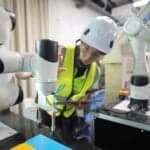


A U.S Company based in Florida has manufactured the TF-179 Drone Boat using robot arms which deposit the material layer by layer, instead of using moulds or machines to create each part separately and then assembling everything.
Haddy has achieved this feat thanks to the advancements in large-format 3D printing using automation. This also demonstrates how additive manufacturing techniques are making their way into the maritime and defence industries.
Not only does 3D printing speed up the manufacturing process, but it also enables the accommodation of changes at any stage of production without the need to start afresh, thus making it easier and faster to produce complex ship designs, offering greater flexibility than traditional methods.
Haddy used the same tech to build the hull of an unmanned surface vehicle and boost production for a client.
According to the company, 3D printing using additive manufacturing can help cut short the development cycles, enabling manufacturers to produce and evaluate new vessel designs in less time.
It is ideal for complex or specialised vessels, such as unmanned vessels, special maritime systems where changes might be required in design to adapt to specific needs or requirements like accommodating a new weapon or sensor, etc.
“As demand grows for specialised maritime platforms, manufacturing methods must evolve alongside them. The ability to rapidly produce, evaluate, and refine complex systems is becoming an increasingly important advantage,” the company posted on its LinkedIn page.
Though it has not been revealed who commissioned the drone boat or what mission it was built for or what technical specifications it has, the company’s work shows its expertise in producing unmanned vessels using robotic 3D printing technology as the demand for such tech, including small maritime drones, increases across the navies of the world.
The company, which was founded in 2022, functions from a 2800 m2 facility in Florida’s St Petersburg and has 8 additive manufacturing platforms which it bought from a robotics firm called CEAD.
Seven of the systems operate using rails, which makes them viable for building large parts, allowing the company to build hulls for drone boats, complete superstructures for boats and uncrewed vessels for the maritime defence sector.
The company’s manufacturing system can produce the parts in days rather than months, all while updating the design on the way, if the client demands to do so.
Haddy said that the system produced a 12 m USV hull from design to shipment in just 10 days, claiming the process is quicker than traditional methods of hull construction.
It also said that the additive manufacturing process used to build vessels reduces cost by 50% to 65% compared to usual methods of boatbuilding.
Want to read more?
Check out the full article on the original site