Iran Says Strait Of Hormuz Under Its Control And Management, Rejects Trump’s ‘Total Control’ Claim
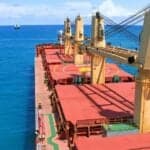


Iran has rejected U.S. President Donald Trump’s claim that the United States has “total control” over the Strait of Hormuz, saying the strategic waterway remains under Iranian control and that vessels cannot pass without Tehran’s permission.
Hossein Taeb, the recently appointed head of Iran’s paramilitary Basij Organisation, said on Thursday that the Strait of Hormuz was under the “management and control” of the Islamic Republic and that Iran was continuing on its path in complete security, according to Iran’s semi-official Fars news agency.
Trump made his claim a day earlier on Truth Social, saying the United States had “total control” of the waterway.
The Strait of Hormuz is a major route for global energy shipments. Before the war, about one-fifth of the world’s oil and liquefied natural gas passed through the waterway.
Iran says vessels need permission to pass
Iran’s joint military command, Khatam al-Anbiya Central Headquarters, said on Thursday that no vessel could pass through the Strait of Hormuz without Tehran’s permission.
It rejected U.S. claims about normal vessel traffic through the strait, calling them “lies and falsehoods” in a statement carried by Iranian state media.
Iran effectively shut the waterway after the U.S.-Israeli war on Iran began on Feb. 28.
The United States later imposed a naval blockade on Iranian shipping and ports. Washington has said it would protect freedom of navigation for vessels travelling to and from non-Iranian ports.
Iranian officials have repeatedly rejected the U.S. claim of control and have said Tehran intends to impose a toll system on the waterway.
Behnam Saeedi, a member of Iran’s parliament and its National Security Commission, said Israeli ships would not be allowed to pass through the strait under any circumstances, whether during war or peacetime.
He also said U.S. military vessels would be barred from passing through the waterway.
Iran sets conditions for reopening
Senior military political official Rasoul Sanaei-Rad said Iran would not reopen the Strait of Hormuz unless the United States met its commitments under an interim agreement aimed at ending the war, Fars reported.
He said reopening the waterway was not something the United States could do on its own.
Sanaei-Rad also warned that Iran would respond more strongly in any future conflict.
Iran and the United States reached an interim agreement in June that extended a ceasefire which had begun in April and called for a quick return to freedom of navigation in the Gulf.
The agreement later broke down, with both countries accusing each other of violating its terms.
Iran resumed limited attacks on vessels it said were not following the agreement. The United States then restarted strikes on Iran’s southern provinces, saying the strikes were intended to reduce Iran’s ability to target vessels in the Gulf.
Iran accuses US of miscalculation
Iranian Foreign Minister Abbas Araghchi also criticised Washington over the Strait of Hormuz.
In a post on X, he said the United States had repeatedly miscalculated because of intelligence failures, including when it launched the war on Iran.
He described Washington’s position on the Strait of Hormuz as an even bigger miscalculation.
“Worse than fake news is fake intelligence,” Araghchi said.
Michael Stephens, a senior associate fellow at the Royal United Services Institute, said Iran was seeking to prolong the war because it believed the economic pressure no longer posed an existential threat to its government.
Iran and Oman discuss new route
Iran and Oman are also discussing a possible new route through the Strait of Hormuz, but the talks have not yet been finalised.
Iran has said that creating an alternative route would not automatically mean the Strait of Hormuz would be reopened.
Mohammad Mokhber, an adviser to Iran’s Supreme Leader Mojtaba Khamenei, said on Thursday that Mojtaba’s strategy would be “offensive war” if Iran’s conditions were not met.
Mokhber said a new regional order could be supported by a Hormuz economic-security mechanism that would operate independently of U.S. military guarantees. He appeared to be referring to an expected agreement between Iran and Oman to organise transit through the strait.
References: Reuters, Al Jazeera
Want to read more?
Check out the full article on the original site