US Navy’s 100,000-Ton Aircraft Carrier John F. Kennedy Completes Acceptance Sea Trials
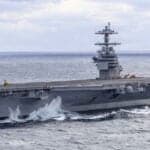


The future USS John F. Kennedy (CVN 79), the U.S. Navy’s second Gerald R. Ford-class nuclear-powered aircraft carrier, has completed acceptance sea trials.
The 100,000-ton aircraft carrier is currently expected to be delivered in March 2027.
Huntington Ingalls Industries (HII) said on Aug. 15 that its Newport News Shipbuilding division had completed the latest phase of testing for the aircraft carrier after it spent three days at sea.
The vessel left Newport News on Aug. 12 and returned on Aug. 15 after undergoing a series of tests to evaluate key ship systems and overall operations.
The successful completion of the trials means the carrier can now move toward preliminary acceptance, allowing the U.S. Navy to begin further testing of systems that are unique to the ship.
During the trials, shipbuilders from Newport News Shipbuilding worked alongside sailors assigned to John F. Kennedy and other Navy personnel to assess the carrier’s performance while underway.
The tests focused on major systems, including propulsion, navigation, combat systems and aviation infrastructure.
“It is an honor to take Kennedy to sea to demonstrate the quality work and commitment by our shipbuilders,” said Derek Murphy, vice president of new construction aircraft carrier programs at Newport News Shipbuilding.
“This critical set of sea trials is a testament to the entire nuclear shipbuilding enterprise and the work of thousands across our country to prepare CVN 79 to join the fleet,” he said.
The latest tests followed the ship’s successful builder’s sea trials earlier this year.
John F. Kennedy first went to sea on Jan. 28 and returned on Feb. 4 after undergoing initial tests of its propulsion, navigation and combat systems.
After those trials, the ship returned to the yard for additional construction work, system integration and other improvements before beginning acceptance testing.
Christened in December 2019, USS John F. Kennedy is the second aircraft carrier in the Gerald R. Ford class.
At 1,106 feet in length, the carrier is one of the largest warships ever built. It is powered by two nuclear reactors and includes several technologies that differ from those used on older Nimitz-class carriers.
The vessel is equipped with the Enterprise Air Surveillance Radar and upgraded weapons elevators designed to increase the number of daily flight operations.
It also features the Electromagnetic Aircraft Launch System (EMALS), which is designed to replace traditional steam catapults used to launch aircraft.
The carrier uses an electromagnetic arresting system instead of older hydraulic systems to recover aircraft during landings.
Another design change is the use of electromagnetic linear motors to move munitions around the ship rather than traditional cable-based systems.
The total cost of the program exceeds $13 billion.
The carrier is also being built under a congressional requirement known as the single-phase delivery approach.
Under this plan, the ship is expected to be capable of operating F-35C Lightning II fighter jets when it is delivered, eliminating the need for modifications after delivery.
According to Newport News Shipbuilding, the carrier is designed to support a higher number of flight operations while requiring fewer crew members. It has also been built to support future technologies, including laser weapons.
The next step will be preliminary acceptance, followed by additional Navy-led testing. The ship will remain a pre-commissioning unit until it is formally accepted and commissioned.
References: navalnews, interestingengineering
Want to read more?
Check out the full article on the original site