US Navy Reconsiders Ford-Class Aircraft Carrier Design As Trump Seeks World War II-Era Look
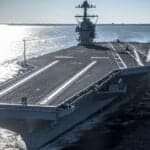


The U.S. Navy is looking at whether to redesign its Ford-class aircraft carriers so they look more like the warships used during World War II.
The change could cost billions of dollars and add further delays to a carrier programme that has already faced long construction times.
The review includes a possible change to the position of the carrier’s large command tower, known as the “island”.
According to a Washington Post report published Saturday, the Navy is considering moving the island farther forward, toward the middle of the ship.
The Ford-class carriers currently have the island closer to the rear. The review follows concerns from President Donald Trump about the appearance of the newer carriers.
Navy considers moving carrier command tower
The Navy looked at moving the island during Trump’s first term. A former senior U.S. official told the Washington Post that the earlier study found the change could cost billions of dollars and cause major delays.
“It came back that the cost and time to do so would just be extraordinary,” the former official said.
The current review is still at an early stage, and it is not clear how or when the Navy could make any changes.
Bryan Clark, a senior fellow and director of the Center for Defense Concepts and Technology at the Hudson Institute, said moving the island would be a major redesign. He said it would also affect the carrier’s weight and buoyancy.
“You could change it,” Clark said, “but it’s very disruptive.”
Three officials told the Washington Post that the island was placed toward the rear of the Ford-class carriers for operational reasons.
The current design gives aircraft more space to park near the catapults. It can also reduce launch times and lower turbulence during aircraft landings.
White House also wants changes to carrier catapults
The island review comes shortly after the White House directed the Navy to reconsider some of the technology used on future aircraft carriers.
A national security presidential memorandum issued Thursday calls for a plan to remove the Electromagnetic Aircraft Launch System, known as EMALS, from the future USS Doris Miller, or CVN-81.
The plan would also remove advanced bomb elevators and return the carrier to older steam-powered and hydraulic systems.
The memorandum, titled “Rebuilding the United States Navy and America’s Shipbuilding Industrial Base,” says the Navy has faced cost increases, delays and cancellations because of complex designs and repeated design changes.
The administration said it wants the Navy to rely more on “proven, reliable, and affordable technologies and ship designs.”
Defense officials have 60 days to prepare a plan covering the proposed changes, including their costs and timelines.
General Atomics, the California company that won a $1.2 billion contract to build EMALS for the carrier, said the decision should be reconsidered.
“With nearly 50 percent of production complete, changing course now would introduce significant cost, schedule and integration risks,” the company said Thursday.
Clark said steam catapults are no longer being produced and that the Navy bought its last set about 20 years ago.
Ford-class carriers already have long construction times
The Ford-class programme has already faced lengthy construction schedules.
The USS Gerald R. Ford, the first ship in the class, took 17 years to build. The construction was delayed in part by the introduction of new technologies.
The carrier also introduced EMALS, which the Navy has said has been highly effective.
Four Ford-class carriers are currently planned: the USS Gerald R. Ford, which is active; the USS John F. Kennedy, which had completed acceptance sea trials; and the USS Enterprise and USS Doris Miller, which are under construction.
The Navy plans to eventually build up to 10 Ford-class carriers to replace the Nimitz-class fleet.
The Congressional Budget Office has projected that future carriers could cost about $22 billion each.
Carrier faces extended Middle East deployment
The proposed design changes come as U.S. carriers are also facing extended deployments in the Middle East amid the ongoing war in Iran.
The USS Abraham Lincoln has spent an extended period in the region. The source material says the carrier has been there for more than 200 days without a port call, while another account puts its deployment at more than 260 days.
Democratic lawmakers have raised concerns about conditions aboard the carrier.
Sen. Richard Blumenthal, a Democrat from Connecticut, wrote to Defense Secretary Hegseth and acting Secretary of the Navy Hung Cao on Wednesday. He cited reports of supply shortages, water contamination and worsening mental health among personnel aboard the Lincoln.
The Navy’s review of the Ford-class island is still ongoing, and no final decision to move the command tower has been reported.
Separately, the administration has given defense officials 60 days to provide a plan for changing the launch and weapons-handling systems on the future USS Doris Miller, including the expected costs and timeline.
References: The Hill, Independent
Want to read more?
Check out the full article on the original site