1,000-Year-Old Viking Ship Burial Reopened In Norway, Archaeologists Find New Clues
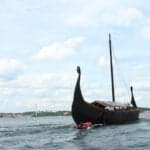


Archaeologists in Norway have found evidence of a Bronze Age grave beneath a Viking ship burial, showing that the same site may have been used for burials centuries apart.
The discovery was made at Grønhaug on Karmøy, on Norway’s western coast. Archaeologists from the University of Stavanger’s Museum of Archaeology have reopened the burial mound, which was first examined in 1902.
The mound contains the remains of a ship believed to have been about 15 metres (49 feet) long. Researchers have found one or two metal rivets that probably came from the ship, along with pieces of preserved timber.
The ship is badly damaged, but parts of its bottom and hull may still be preserved inside the mound.
Archaeologists reopen 1902 excavation
Archaeologist Haakon Schetelig first investigated Grønhaug in 1902 and confirmed that a ship had been buried inside the mound.
His team removed some loose pieces of ship planking from around the oar holes and took them to Bergen. Much of the remaining wood was left inside the mound because it was too soft to remove.
More than 100 years later, archaeologists Marie Ødegaard and Håkon Reiersen have returned to the site to check its condition and study what remains.
They have reopened almost the same trench used by Schetelig, with a small extension. The team is not excavating the entire mound.
The researchers also found timber that Schetelig had discarded during the 1902 excavation. The wood appears to be pine rather than oak. Viking ships were generally built with oak hulls, but pine could have been used for other parts of a ship.
Ødegaard said the timber may have come from a roof, superstructure or another object placed on the ship.
Bronze Age grave found underneath
The most important discovery so far was made beneath the Viking burial.
Archaeologists found a man-made stone cairn covered by layers of soil and turf. Stones had also been arranged around its base, forming what is known as a kerb.
The researchers believe the structure probably dates to the Bronze Age, although more samples and dating work are needed to confirm its age.
If confirmed, the finding would show that the site was used for burial long before the Viking ship was placed there.
The older mound may have provided a platform for the later Viking burial.
Grønhaug is located among several large burial mounds on Karmøy, including some that date to the Bronze Age.
Plants from the time of the Viking burial preserved
The excavation has also revealed traces of vegetation that was growing when the Viking mound was built.
Marie Ødegaard told Science Norway that she could see blueberry plants and heather that were growing at the site at the time. Some of the plants still had their leaves.
The discovery suggests that the mound was built during the warmer part of the year, when the vegetation was growing.
It also shows how well some organic material has survived inside the mound for more than 1,000 years.
Birch bark raises new questions
Archaeologists have also examined a layer of birch bark found inside the mound.
Earlier, researchers thought the bark might have been linked to looting that took place toward the end of the 10th century. It may have been used to make it easier for people to walk through the mound without getting wet.
Another possibility was that it had a ritual purpose.
Researchers are now considering whether the birch bark was actually part of the original construction of the mound.
The burial was looted in the past, which is common at ship burial sites. Despite this, researchers say the preservation conditions inside Grønhaug appear to be very good.
Researchers still studying the ship’s age
The exact date of the Grønhaug ship has been debated.
Earlier research suggested that the ship dated to around 780, with the burial taking place a little more than a decade later. That would have placed it just before the Viking Age.
More recent reviews of dendrochronological and radiocarbon evidence suggest that the ship dates to around 864. That would place it within the Viking Age. The burial mound itself may be a few years older.
The Oseberg ship burial, another well-known Viking ship burial in Norway, dates to around 820.
Researchers hope the latest excavation and new samples will help establish a more accurate date for Grønhaug.
Most of the mound will remain untouched
The excavation was commissioned by the Norwegian Directorate for Cultural Heritage in cooperation with Rogaland County Municipality.
It is part of a wider effort linked to proposals to recommend additional Viking sites for inclusion on the UNESCO World Heritage List.
For now, archaeologists are leaving most of the mound untouched. They are examining the condition of the surviving wood, metal and other organic material and collecting samples for further dating.
The researchers will also continue studying the relationship between the Viking ship burial and the older monument beneath it.
References: tcd, sciencenorway
Want to read more?
Check out the full article on the original site