World’s Largest Warships Can Now 3D Print Their Own Broken Parts At Sea
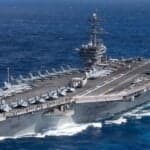


The U.S Navy’s Nimitz-class aircraft carrier USS Theodore Roosevelt (CVN 71) successfully integrated a 3D hybrid-metal printer while underway for Rim of the Pacific Exercise (RIMPAC) on July 3, 2026.
This is the first time a containerised manufacturing platform which can fabricate new parts as well as repair metal components was operational on an active U.S Navy warship at sea.
The system, known as the ADDiTEC HYBRiD-X, allows personnel to manufacture broken parts that need to be replaced on the ship itself.
Unlike traditional manufacturing methods, which cut material from a large piece, additive manufacturing builds everything in layers using digital designs, which not only reduces wastage but also does away with supply chain issues.
It enhances unit-level self-sufficiency during extended deployments.
“We now can diagnose the problem and come up with a solution,” said U.S. Navy Aviation Structural Mechanic 1st Class Scott Barber, assigned to the aircraft carrier.
“The entire idea is to be able to cut down lead time by a significant amount. This allows us to maintain capabilities and operational readiness.”
This initiative is being led by the Naval Postgraduate School’s Consortium for Advanced Manufacturing Research and Education (CAMRE) in Monterey, California, alongside FLEETWERX and the Marine Innovation Unit (MIU).
Members of the MIU, a specialised Marine Corps reserve unit headquartered in Newburgh, New York, helped in the system’s integration by bringing private-sector technological expertise to shipboard operations.
“We have been successful integrating because of Sailors and Marines willingness to learn and work together,” said U.S. Marine Corps Sgt. Ronald Bair, an MIU subject matter expert aboard the ship.
“Getting exposure to different parts and machines has helped me learn and improve while also training sailors how to use the new equipment.”
Before being deployed on the USS Theodore Roosevelt, the hybrid manufacturing platform underwent extensive tests in shore-based environments and smaller expeditionary units.
Want to read more?
Check out the full article on the original site