Trump Says No US-Iran Talks Planned Amid Strait Of Hormuz Standoff
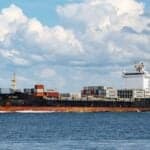


U.S. President Donald Trump said on Tuesday that there are no talks taking place with Iran and none are planned, even as Tehran continued to insist that the Strait of Hormuz remains closed to shipping.
The disagreement comes as traffic through the key shipping route remains extremely low.
A vessel was struck while leaving the strait on Tuesday, and the United Arab Emirates reported detecting two ballistic missiles launched from Iran.
The situation continues to affect global shipping and energy markets. Before the conflict began nearly six months ago, around 20% of the world’s oil trade passed through the Strait of Hormuz.
“There are no talks or conversations going on, or scheduled, with the Islamic Republic of Iran,” Trump wrote on Truth Social.
He added that the U.S. naval blockade of Iranian ports remained in place and said the Strait of Hormuz was open and operating.
Trump’s comments differed from statements made a day earlier.
On Monday, he said the United States was engaged in back-channel talks with Iran, a claim that Tehran denied. On the same day, Jared Kushner, Trump’s son-in-law and special envoy, said discussions with Iran were continuing and were stronger than ever.
Later, a U.S. official told Al Jazeera that discussions with Iran had been positive, but Trump had decided to pause further engagement until Tehran was ready to make a deal.
The latest comments came after a 60-day period outlined in a memorandum of understanding signed on June 17 expired on Monday.
The agreement was intended to create a framework for negotiations on Iran’s nuclear program and U.S. sanctions while ending military operations.
Trump said he had no plans to extend the agreement.
Iranian officials maintained that the Strait of Hormuz would remain closed until Washington met the conditions of the June deal.
Mohammad Baqer Qalibaf, Iran’s top negotiator, said those conditions included ending the U.S. blockade of Iranian ports, lifting oil sanctions, releasing Iran’s frozen assets, and ending military operations and threats.
Mohammad Mokhber, an adviser to Iran’s supreme leader, said Iran remained willing to negotiate but would not accept surrender.
Iranian Foreign Minister Abbas Araghchi said discussions with Oman on a new maritime route through the Strait of Hormuz were continuing.
The talks between Iran and Oman have added to tensions with Washington.
Trump has criticised Oman’s involvement and recently threatened military action if the country interfered with U.S. operations. On Tuesday, he also shared an image on Truth Social describing the Strait of Hormuz as a “New U.S. Territory.”
Despite Trump’s claim that the waterway is open, shipping activity remains limited.
Preliminary shipping data showed that vessel crossings through the strait remained in single digits on Monday. According to ship-tracking company Kpler, only three vessels passed through the waterway on Sunday.
Security concerns also continued.
The United Kingdom Maritime Trade Operations agency said a vessel sailing out of the Strait of Hormuz was hit by an unknown projectile on Tuesday.
The strike damaged the vessel’s engine room and caused one crew casualty. The remaining crew members were being assisted by the Omani Coast Guard.
There was no immediate response from Iran.
Separately, the UAE’s Defense Ministry said it detected two ballistic missiles launched from Iran on Tuesday.
The ministry initially said both missiles landed in the sea. It later said one missile fell outside the country’s territorial waters, while the second landed within them.
The UAE said its assessment showed that the missiles were aimed at maritime traffic.
Iranian Foreign Ministry spokesperson Esmaeil Baghaei rejected the accusation and called it baseless.
The UAE later announced that it was suspending trade, financial transactions and commercial exchanges with Iran until further notice, citing growing regional tensions.
The move could affect trade that had only recently resumed. Direct cargo shipping between the UAE and Iran restarted in late June through Dubai’s Jebel Ali Port after being suspended in early March.
Brent crude futures rose for a third straight session on Tuesday and settled slightly above $91 per barrel. During the conflict, prices had climbed as high as $126 per barrel.
A senior Iranian official told Reuters that Tehran had moved to a “fully offensive” military posture because negotiations had stalled, although there were no reports of new strikes on Tuesday.
At the same time, U.S. officials said Washington could increase economic pressure on Iran through additional sanctions.
Analysts at Eurasia Group said they no longer expected a peace agreement by September and had moved their expectations for de-escalation to the end of the year.
References: Reuters, Al Jazeera
Want to read more?
Check out the full article on the original site