Passenger Ferry Capsizes On Zimbabwe’s Lake Kariba, Killing 94 In Country’s Deadliest Transport Disaster
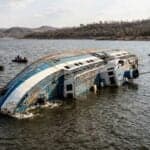


The death toll from the capsizing of a government-owned passenger ferry on Zimbabwe’s Lake Kariba has risen to 94, with the government saying the vessel was carrying about 180 passengers and cargo, exceeding its reported capacity.
The Mbuya Nehanda capsized on Aug. 11 while travelling from Kariba town in northern Zimbabwe to Chalala, a remote community on the lake. The accident is now Zimbabwe’s deadliest public transport disaster, surpassing a 1991 bus crash that killed 89 people.
Police said last week that the ferry was licensed to carry 90 passengers. The government said on Tuesday that around 180 passengers and goods were on board, although it did not specify the vessel’s exact maximum carrying capacity.
Police confirmed 94 deaths on Tuesday, while 77 people have been rescued. Search and recovery operations are continuing.
The number of confirmed deaths and survivors means at least 171 people were on board. Other reports had earlier put the number of people aboard at up to 153, while available information also indicated that the ferry was carrying at least 114 adults, five crew members and an unspecified number of children.
Local government minister Daniel Garwe said the government would hold an inquest to establish what led to the capsizing.
Garwe placed much of the blame on the ferry’s captain, 59-year-old Sign Patsikadova, who died in the accident. He said the vessel had a valid fitness certificate and that the disaster was caused by negligence and human error rather than the ferry’s fitness.
Garwe said the meteorological department had warned that strong waves were developing on the Binga side of Lake Kariba and had advised that sailing should be stopped.
According to Garwe, the captain ignored the warnings, loaded the ferry and continued with the journey.
Passengers had also raised concerns about the weather before the ferry left. Survivors later said they asked the captain to turn back or seek shelter at a nearby island as conditions worsened, but he refused.
The Mbuya Nehanda was an ageing ferry that was reportedly donated to the Zimbabwean government in 1985. It was operated by Zimbabwe’s Rural Infrastructure Development Agency and provided a transport link between Kariba and Chalala, an isolated community about 50 km away by water. The journey by road is more than 400 km.
The ferry was operating with only one functioning engine.
About 30 minutes after departure, waves began washing over the vessel and water started collecting inside. Water later entered the engine compartment and submerged the mechanical bilge pump, preventing it from pumping out the incoming water.
As the ferry began to list, the captain told passengers to move to one side in an attempt to correct the imbalance. A witness said a wave may have caused the engines to switch off. The vessel later turned broadside to the waves and capsized near Long Island.
Some passengers struggled to use life jackets or could not find them during the accident. Survivors stayed afloat by holding on to floating objects or climbing onto the overturned hull.
A rescue boat from Tashinga, together with personnel from the Zimbabwe Parks and Wildlife Management Authority and local boat operators, reached the scene at about 2 p.m. and rescued 77 people from the water and the overturned ferry. Two of the five crew members survived.
Police released the names of 39 more victims on Tuesday, bringing the number of identified bodies to 83. Authorities had previously identified 44 victims on Aug. 14.
Among those who died was Tehillar Matembeka, a one-month-old child from Mola Village in Siakobvu.
Garwe said seven families had reported that the bodies of their relatives were still unaccounted for. Based on those reports, he said the death toll could reach 99 or more than 100.
The government has pledged to rehabilitate the affected roads and provide a replacement vessel. The accident has also disrupted transport and trade for communities that depend on the Chalala route.
President Emmerson Mnangagwa declared a state of disaster following the accident and acknowledged shortcomings in Zimbabwe’s maritime capabilities.
Lake Kariba lies on the border between Zimbabwe and Zambia and is one of the world’s largest man-made reservoirs. It is also described as the world’s largest artificial lake by volume.
References: Reuters, ZimLive
Want to read more?
Check out the full article on the original site