Russian Warship Escorts Gazprom LNG Tanker Along Norwegian Coast As Arctic Shipping Season Peaks
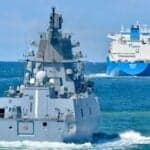


A Russian Northern Fleet frigate has been escorting a Gazprom-operated LNG carrier from the Baltic Sea toward Murmansk, with the vessels sailing north along the Norwegian coast on Aug. 20.
The frigate Admiral Kasatonov was accompanying the LNG carrier Portovyy, which had left Gazprom’s Portovaya LNG plant in Russia’s Vyborg district near the Finnish border carrying a cargo of liquefied natural gas.
Ship-tracking data showed Portovyy was heading for Murmansk and was expected to arrive on Aug. 22. It could continue east along the Northern Sea Route and eventually head to China, according to the source material.
Portovyy is owned and operated by Gazprom LNG Portovaya, a subsidiary of Gazprom. The 277-metre carrier serves the company’s small-scale Portovaya LNG plant, which has a capacity of 1.5 million tonnes per year.
According to the source material, this was Portovyy’s first departure from the Portovaya LNG plant since the facility began operating in autumn 2022.
Reports tracking Russian warships said Admiral Kasatonov accompanied the LNG carrier through the Baltic Sea and as it left the region.
Other LNG Carriers Also Moving North
Two other LNG carriers linked to the Portovaya project are also moving in the same direction.
The carrier Valera was returning from a voyage to China and was following Portovyy north. Another vessel, Perle, was also returning from China via the Northern Sea Route. On Aug. 20, Perle was heading toward the Bering Strait.
The reason for the movements is not known.
The source material said Portovyy could continue along the Northern Sea Route to China or transfer its LNG cargo to Valera or Perle. The vessels could then potentially be used to support the sanctioned Arctic LNG 2 project.
Arctic LNG 2 has been able to deliver LNG to China despite sanctions, but the project faces a shortage of vessels.
The project was sanctioned in the fall of 2023 and can operate in two stages with a combined LNG production capacity of 13.2 million tonnes, or 18 billion cubic metres of gas, per year.
According to the source material, the project has 12 conventional LNG carriers and two ice-class tankers, which are not enough to transport all of its potential production.
Northern Sea Route Enters Busy Shipping Period
The movements come during the peak navigation season on the Northern Sea Route, when sea ice is at its lowest level and shipping activity increases.
Dozens of vessels were sailing on the eastern section of the route in mid-August, including oil tankers without ice-class protection.
Ice maps from Aug. 18 showed that much of the route was ice-free. However, belts of sea ice remained in the western part of the Laptev Sea and in the East Siberian Sea.
The Arctic route keeps Russian ships away from Ukrainian drone attacks and possible action by Western coast guards, but ships still face harsh weather and changing ice conditions.
Russian Navy Has Escorted Other Commercial Ships
Admiral Kasatonov belongs to Russia’s Northern Fleet and is based at Severomorsk on the Kola Peninsula. It is one of the fleet’s more modern warships.
Other Northern Fleet vessels, including Admiral Levchenko and Severomorsk, have also been involved in escorting commercial ships.
Severomorsk was deployed in the Baltic Sea from December 2025 and was tasked with ensuring the safety of vessels carrying cargo in Russia’s interests, according to the Northern Fleet.
In a July 24 edition, the Northern Fleet newspaper Na Strazhe Zapolyarya said its sailors had carried out the task of protecting such vessels and that no representative of navies from countries it described as hostile to Russia had challenged the ships under their protection in the Baltic Sea.
Severomorsk was later deployed to the Mediterranean, including Syria, where it also escorted civilian vessels operating in Russia’s interests.
Portovaya LNG Project Under Sanctions
The Portovaya LNG plant was launched in September 2022. It initially supplied LNG to Greece and Turkey. In 2024, a significant share of its cargoes went to China, while one carrier also delivered LNG to Spain and smaller vessels sailed to Zeebrugge in Belgium.
The United States imposed sanctions on the Portovaya LNG complex in January 2025. The project then shifted its focus toward Asia after facing difficulties selling its LNG.
According to the source material, the project’s LNG carriers remained idle off the coast of China for months. The first two cargoes after the sanctions were handed over in China only in autumn.
Since the sanctions were imposed, the project has exported six cargoes, while the rest of its LNG was supplied to Russia’s Kaliningrad region.
The floating storage and regasification vessel Marshal Vasilevsky arrived at the plant’s berth on Aug. 11 and satellite images showed it was still alongside on Aug. 20.
Marshal Vasilevsky is used to supply the Kaliningrad region but has previously also delivered LNG abroad. According to the source material, it could remain at Portovaya, return to Kaliningrad with LNG or potentially be used on a route to China.
References: thebarentsobserver, eadaily
Want to read more?
Check out the full article on the original site