Video: Unmanned Surface Vessel Fires 2 JAGM Missiles During RIMPAC 2026 Off Hawaii
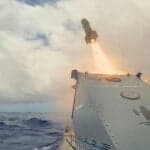


Saildrone and Lockheed Martin have launched two Joint Air-to-Ground Missiles (JAGM) from an unmanned surface vessel during the U.S. Navy’s RIMPAC 2026 exercise off Hawaii.
The test marked the first missile launch from a Saildrone unmanned surface vessel (USV). It was conducted under the U.S. Navy Fleet Experimentation Program (FLEX), in coordination with the USS Theodore Roosevelt (CVN-71) Carrier Strike Group.
The Saildrone Surveyor used the Navy’s Adjunct Remote Engagement System (ARES), a remotely operated combat system, and acted on target data for a surrogate high-speed surface craft.
The companies said the system went from the initial concept to the live-fire demonstration in six months.
Missile test at RIMPAC
The 20-metre (66-foot) Saildrone Surveyor was fitted with a JAGM dual launcher and ARES fire-control command-and-control system.
During the exercise, the USV launched two JAGM rounds against a surrogate target. The test was carried out near Hawaii as part of RIMPAC 2026, described by the companies as the world’s largest international naval exercise.
The Surveyor also demonstrated a passive electronic warfare capability during the exercise. Working with an MH-60S helicopter, the system detected, classified and identified a surrogate threat radar system.
The demonstrations showed the platform operating with both electronic warfare sensors and a missile system.
Six months of development
The live-fire test followed six months of joint work between Saildrone and Lockheed Martin. The two companies formed a strategic partnership in October 2025.
The partnership combines Saildrone’s commercially developed USVs with Lockheed Martin’s combat-tested weapons and defense systems.
“This successful live-fire demonstration was the result of pairing one of the most tried and trusted munitions with the most operationally deployed class of USV on the planet,” said Richard Jenkins, Saildrone’s founder and CEO.
Jenkins said the test provides a kinetic capability for the Surveyor and also helps the companies prepare to integrate more advanced systems, including the Lockheed Martin Mk 70 launcher, onto the larger Saildrone Spectre.
Paul Lemmo, vice president and general manager of Sensors, Effectors and Mission Systems at Lockheed Martin, said the companies would continue investing in capabilities intended to speed up the deployment of unmanned and autonomous naval technologies.
Larger Saildrone Spectre
The RIMPAC test is part of a series of planned integrations involving Saildrone’s larger Spectre USV.
The Spectre is 52 metres (170 feet) long and is designed to carry larger, containerised mission systems and payloads. The first vessel is currently under construction.
With a full payload, the USV is expected to weigh about 300 tonnes and reach speeds of up to 30 knots. Its concealed payload deck can hold up to five 20-foot containers or two 40-foot containers.
Spectre will have two variants, with or without Saildrone’s patented Wing. The company says this will provide options for near-silent transits for acoustically sensitive missions or a lower profile for high-speed kinetic operations.
Future plans include integrating the Lockheed Martin Mk 70 launcher and towed arrays designed to support anti-submarine warfare.
What the Surveyor can do?
The Saildrone Surveyor is a 20-metre USV designed for long-duration maritime missions. These include intelligence, surveillance and reconnaissance, deep-ocean mapping and other maritime operations.
It can operate autonomously in harsh environments and remain on station for months.
The vessel uses radar, electro-optical/infrared sensors, machine-learning-based detection, passive acoustics and AIS to maintain situational awareness.
The JAGM dual launcher was newly integrated with the platform for the RIMPAC demonstration.
Lockheed Martin said JAGM uses a dual-mode seeker combining semi-active laser and millimetre-wave technology. The companies said the missile has demonstrated performance across air, maritime and ground domains and can support counter-unmanned aircraft systems (C-UAS) missions.
References: lockheedmartin, Saildrone
Want to read more?
Check out the full article on the original site