U.S Navy’s First Flight III Destroyer’s New SPY-6 Radar Defends Against Simulated Threats In Pacific Dragon 2026
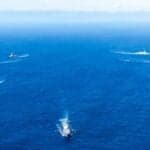


The U.S. Navy’s new radar system, the Raytheon-built AN/SPY-6, completed its latest operational test alongside allied warships during the Pacific Dragon 2026 military exercise off the coast of Hawaii.
Operating aboard the USS Jack H. Lucas, the Navy’s first Flight III destroyer with the upgraded Aegis Baseline 10 combat system, the radar tracked and responded to air and missile threats across different defence scenarios.
The exercise ended on August 15 at the Pacific Missile Range Facility near Kauai and was led by the U.S. Third Fleet and the Missile Defence Agency.
It brought together military forces from Australia, Italy, Japan, and South Korea, alongside Chile and Spain, which participated for the first time.
Participants shared real-time data and evaluated operational processes together to counter airborne threats and come up with better strategies.
Raytheon developed the SPY-6 to replace ageing radar systems with significantly higher sensitivity, longer detection ranges, and sharper target identification.
The system can simultaneously defend against a wide variety of hazards, including ballistic, cruise, and hypersonic missiles, as well as enemy aircraft and surface ships.
Its precise tracking data directly feeds the Navy’s weapon systems, boosting the target accuracy of every Standard Missile variant. A key feature of the SPY-6 is its modular design, which relies on standardised radar building blocks that can be scaled to fit different ship sizes.
This common hardware setup lowers maintenance costs while improving reliability. The technology is currently being deployed across seven classes of Navy ships, equipping new destroyers, frigates, aircraft carriers, and amphibious vessels, while also being retrofitted onto older destroyers and carriers.
During the drills, the Missile Defense Agency collected live-tracking data to fine-tune the Aegis Ballistic Missile Defence system and validate sensor performance.
By demonstrating seamless data-sharing among partner fleets, the test highlights growing international cooperation and readiness to secure Pacific waterways against high-tech maritime threats, especially drones.
Want to read more?
Check out the full article on the original site