World’s Largest Heavy-Lift Vessel Delivers 16,000-Tonne Oil Platform To Shetland For Decommissioning
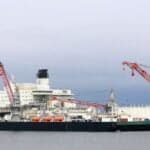


The world’s largest heavy-lift vessel, Allseas’ Pioneering Spirit, has brought the North Cormorant oil platform to Shetland for decommissioning after more than 40 years of production in the North Sea.
The 382-metre (1,253-foot) vessel arrived at Lerwick Harbour early on Saturday carrying the 16,000-tonne platform topsides. The structure was then transferred to a barge that will take it to Dales Voe, where it will be dismantled and recycled.
North Cormorant is the largest platform ever brought into Lerwick Harbour for decommissioning. The project is also the third major platform decommissioning operation at the port.
The dismantling work will be carried out by Brown and Mason Group, working with Peterson Energies.
The onshore demolition is expected to take about 12 to 14 months, while the overall project is expected to last around 18 months. About 30 people are working on the project.
The companies expect to recycle up to 97% of the steel and other materials recovered from the platform.
Pioneering Spirit carries platform from the North Sea
Pioneering Spirit began its journey from the North Cormorant field, around 110 nautical miles northeast of Lerwick, shortly before 8 p.m. on Friday, according to vessel-tracking information.
The vessel reached Shetland about 12 hours later.
The twin-hull Pioneering Spirit is 382 metres long and 124 metres wide. It has a 5,000-tonne crane and was designed to install and remove large offshore platforms.
Allseas says the vessel can remove platform topsides weighing up to 60,000 tonnes and jackets weighing up to 20,000 tonnes. It can also install ultra-heavy pipelines at any water depth.
After arriving in Lerwick, the North Cormorant topsides were moved onto a barge for the trip to Dales Voe.
The Lerwick Port Authority issued a notice to mariners covering 10 days of increased activity in the Dales Voe area. Ships operating there have been told to keep at least 500 metres away from vessels moving to or from the site.
North Cormorant produced 467 million barrels of oil
North Cormorant was installed in 1981 and began production in February 1982. It operated as a manned drilling and production facility in the East Shetland Basin until production ended in June 2024.
During its 42-year operating life, the platform produced 467 million barrels of oil. The oil was transported through the Brent pipeline to the Sullom Voe terminal in Shetland.
The field was discovered in 1974 by Shell and Esso, with the platform installed seven years later.
Former worker watches platform return
The arrival of North Cormorant was particularly significant for Colin Nicolson, Deputy Chairman of Lerwick Port Authority. He worked on the platform as a technician between 1987 and 1995.
Nicolson said he spent eight years on board and worked in many parts of the platform, including the drilling derrick and the top of the flare stack. His duties included gas testing, and he was also part of the emergency response team, working as a fireman and advanced first aider.
He said seeing the platform return brought back old memories but was also rewarding because the project provides work for Lerwick Harbour and the Shetland supply chain.
TAQA decommissioning programme
The North Cormorant project is part of a larger contract awarded by TAQA, the Abu Dhabi-based energy company that owns the platform, to Allseas.
The contract covers the removal of four platform topsides and three steel supporting jackets. The programme aims to reuse or recycle at least 95% of the materials recovered.
The decommissioning programme includes topsides removals planned between 2026 and 2028, with completion expected by 2029.
North Cormorant will be dismantled alongside other platform removals covered by the contract, with Allseas coordinating the wider work. It is the third major platform to be brought to Lerwick for decommissioning.
The port authority hopes to secure more work as North Sea oil and gas production declines. It also has plans for a deep-water quay that could support larger vessels and future decommissioning projects.
References: BBC, theukpulse
Want to read more?
Check out the full article on the original site