Record-Breaking Icebreaker Nordica Heads To Canadian Arctic Ahead Of Winter Season
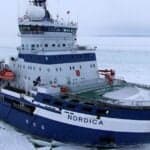


The multipurpose icebreaker Nordica left its home port of Kotka in Finland on August 23, 2026, for a deployment supporting the operations of the Canadian Coast Guard in the harsh Arctic region.
According to reports, the Finnish vessel will arrive at St. John’s, Newfoundland and Labrador, by September 5. It will then sail north and begin its ice-clearing task to enable shipping operations in the Arctic waters and also provide ice-management services.
The 116-metre-long vessel was constructed in 1994 at Rauma’s Aker Finnyards shipyard.
With a 12,800-tonne displacement and a diesel-electric propulsion system which delivers 15 MW of power, the vessel boasts a 230-tonne bollard pull in challenging ice conditions.
The one-year deployment comes as a result of a charter between Arctia, a vessel operator owned by the Finnish government and Qikiqtaaluk Horizon Arctic Services (QHAS), owned by the Inuit.
Under this agreement, Horizon Naval Engineering is Arctia’s contractual partner and the Canadian Coast Guard is the customer. The agreement can be extended in the future, if needed, according to authorities.
The Canadian Coast Guard said that through this charter, the MSV Nordica would aid in icebreaking and environmental missions, and search and rescue efforts in the region. Arctia said that Nordica’s duties would not involve defence or law enforcement activities.
Nordica holds the 2017 record for the earliest crossing of the dangerous Northwest Passage, where it completed a trip spanning six thousand miles from Vancouver to Greenland in 24 days.
It has also been a part of several challenging offshore projects and missions in the Beaufort and Chukchi seas. Nordica supported Shell’s exploratory drilling campaign in the Alaskan Arctic in 2012.
The deployment reflects a trend of increasing international cooperation in polar regions under the ICE Pact, which was signed between Finland, the U.S and Canada.
The pact focuses on jointly developing new icebreakers by pooling industrial resources. One such vessel built under the agreement is Canada’s Polar Max, whose hull is under construction at the Helsinki shipyard.
The schedule of Nordica’s Canadian mission fits within Finland’s domestic icebreaking needs.
After completing its deployment in the Arctic, the vessel will be returning to the Baltic Sea by December this year, where it will assist commercial ships by clearing ice in Finnish waters.
Want to read more?
Check out the full article on the original site