Bees, Blossoms and Bottles
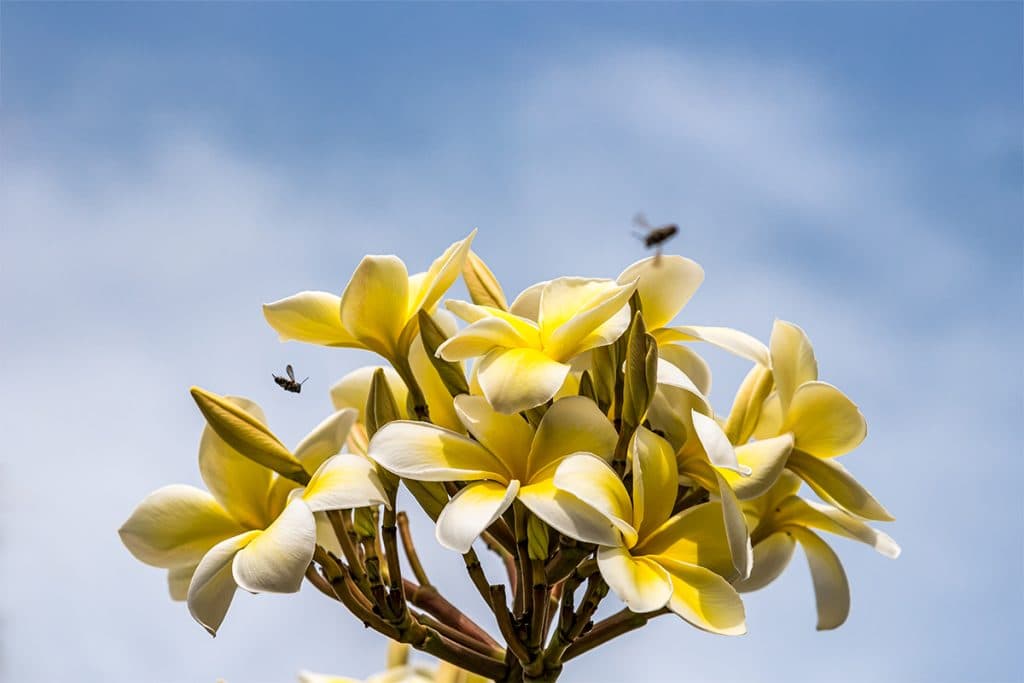
This story was originally published in our SUMMER Digital issue, which you can view here.
They say the flutter of a butterfly’s wings can set off a ripple effect half a world away, that a single moment or seemingly small decision can alter the course of generations. Much the same could be said for the honeybee. When the first honeybees arrived in the Hawaiian Islands in 1857, few could have predicted the profound impact their tiny wings would have on Hawaiʻi’s ecosystems, agriculture and economy.
Long before the arrival of the European honeybee (Apis mellifera), Hawai‘i was already home to its own native pollinators. Also known as Nalo meli maoli, the Hawaiian yellow-faced bee (Hyaleus genus) plays a vital role in sustaining native ecosystems by pollinating plants such as ‘ōhiʻa lehua, naupaka and ‘ilima, but it does not produce honey.
Many may wonder why honeybees were introduced to the Islands at all, especially when Hawai‘i already had its own native pollinators. To understand that decision, one must look back to the 1850s and the reign of King Kamehameha III, Kauikeaouli. Under his leadership, the Royal Hawaiian Agricultural Society was established to advance commercial agriculture, expand cash crop production, and strengthen the Hawaiian Kingdom’s sovereignty through economic growth. Among the topics that captured the group’s attention was the growing importance of honeybees in global agriculture, not only as pollinators, but also for the economic potential of the honey and beeswax they produce.
In 1851, the society appointed a three-member committee to oversee efforts to introduce honeybees to the kingdom. Its first attempt came the following year, when hives were ordered from New Zealand. But because of a miscommunication, the bees were never sent.
Undeterred, fellow society member Henry A. Pierce, a partner of Charles Brewer, sought another route. In 1852, he contacted associates in Boston and arranged for a hive to be transported aboard the R. B. Forbes. Over the course of 180 days, the ship crossed tropical waters and rounded Cape Horn at the southern tip of South America. Extreme heat during the journey melted the honeycomb aboard the vessel, ultimately killing the bees before they could reach Hawai‘i.
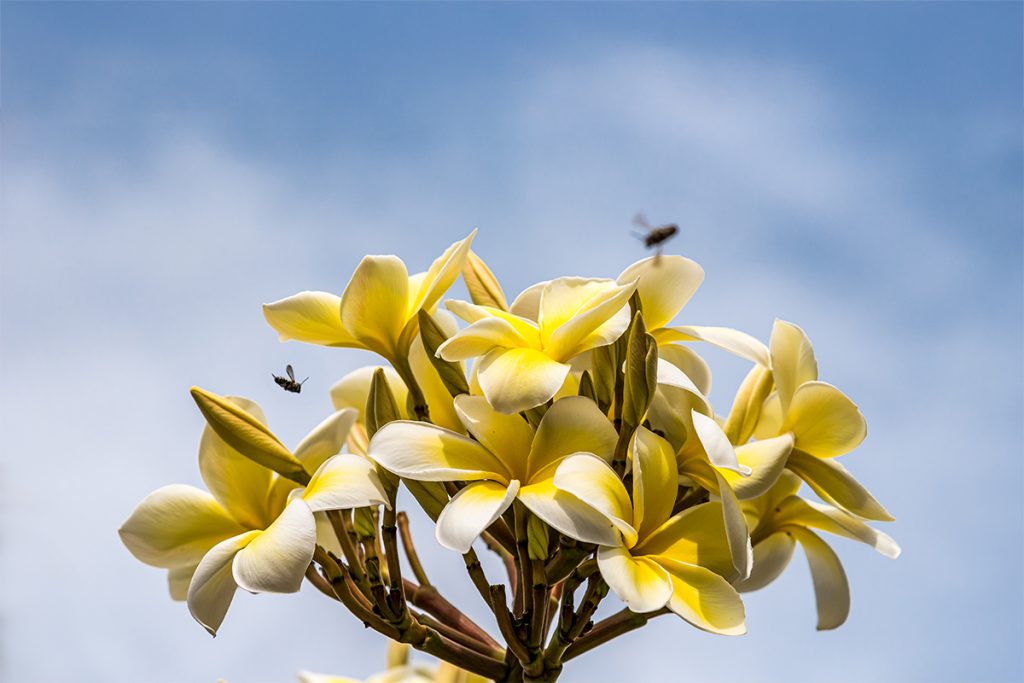
Photo: Getty Images/Paul Morton
Pierce made a second attempt in 1853, requesting two hives be shipped from Boston, with one packed inside a block of ice and fitted with a small ventilation pipe so the bees could breathe during their voyage. The ice-packed hive survived the journey. However, of the tens of thousands of bees shipped, only about 40 bees were still alive upon arrival. Despite the losses, the hive was auctioned and purchased for $13 by Charles Reed Bishop, a member of the Royal Hawaiian Agricultural Society and husband of Princess Bernice Pauahi Bishop. Hopes for establishing a colony were short-lived, however, as the remaining bees soon perished.
Years passed as the society continued its pursuit of honeybees and the economic promise they represented. Eventually, the society appealed directly to the public, offering a $10 reward to anyone who could successfully transport live bees to Hawai‘i.
Success finally arrived on Oct. 21, 1857, when three hives of German dark bees were shipped from San Francisco to Honolulu by William Buck aboard the Fanny Major. After an 18-day voyage across the Pacific, the hives arrived in the Islands, a turning point that marked the successful introduction of honeybees to Hawai‘i. The society purchased the hives for $100 each and placed them in the care of Dr. William Hillebrand, a renowned botanist and society member. Hillebrand transported the bees to his home in Nu‘uanu Valley, where the colonies flourished. From the original three hives, he expanded to nine and established feral honeybee colonies across O‘ahu, laying the foundation for the species’ spread throughout the Hawaiian Islands.
After successfully establishing honeybee colonies on O‘ahu, the society turned its attention to the rest of the island chain. In the years that followed, honeybees were introduced throughout Hawai‘i, largely to support the pollination of kiawe trees, which had become increasingly valuable to the growing cattle industry.
Kiawe (Prosopis pallida), native to South America, was introduced to Hawai‘i in 1828 by the Rev. Alexis Bachelot, head of the first Catholic missions to the Islands. The hardy trees thrived in Hawai‘i’s hot, dry climate and produced protein-rich seed pods that could be used as nutritious cattle feed, and their sprawling canopies provided shade for the grazing herds. Honeybees helped improve kiawe pollination and seed production, intertwining the future of Hawai‘i’s cattle industry with the success of the newly introduced insects.
By the 1890s, beekeeping was flourishing across the Hawaiian Islands. In 1894, Hawai‘i exported its first shipment of honey to the United States, just 4 gallons, but a milestone that signaled the beginning of a new industry. By 1897, more than 109,000 pounds of honey was exported from Hawai‘i. Much of that growth was fueled by the Islands’ favorable climate, which allowed bees to forage year-round and enabled continuous honey production.
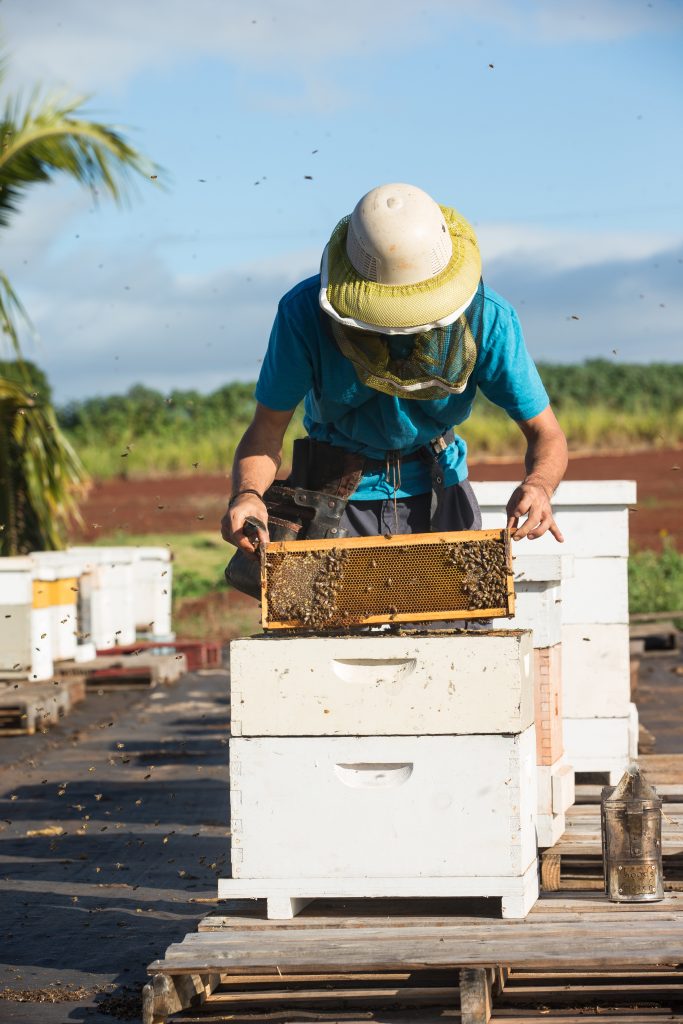
Photo: David Croxford
Today, beekeeping remains an important part of Hawai‘i’s agricultural economy, even as the role of introduced honeybees continues to spark thoughtful discussion among conservationists, farmers and researchers. While honeybees can compete with native pollinators for floral resources and, in some areas, dominate access to nectar, they also provide significant economic and agricultural benefits. According to the Hawai‘i Department of Agriculture’s Market Analysis & News Branch, the farm value of honey production was approximately $3 million in 2021.
The value of honeybees extends beyond honey production. They are vital pollinators for a range of agricultural crops, including macadamia nuts, coffee and citrus, helping to support both food production and farm profitability. As a result, even folks who oppose the idea of non-native species in the Islands recognize the benefits that honeybees provide and the need for a balanced approach. But, they say, any potential negative impacts on Hawaiʻi’s distinct native ecosystems must be addressed, and honeybee advocates say they agree.
Efforts to achieve that balance often include removing unmanaged feral colonies, strengthening disease monitoring and control programs, and establishing buffer zones to reduce interactions between introduced honeybees and native Hawaiian plants. These measures aim to preserve the local ecological integrity of Hawai‘i’s fragile environments while ensuring that managed honeybee populations can continue to support agriculture.
The story of introduced species in Hawai‘i is often one of unintended consequences. While honeybees, like introduced cattle and mongooses, have contributed to ecological challenges that were never anticipated, they have also generated unexpected benefits. Beyond supporting agriculture, honeybees have inspired new artisanal traditions that celebrate Hawai‘i’s unique sense of place. One example is the growing use of locally produced honey in hyperlocal meads, transforming a species introduced to the Islands into a catalyst for innovation, craftsmanship and local flavor.
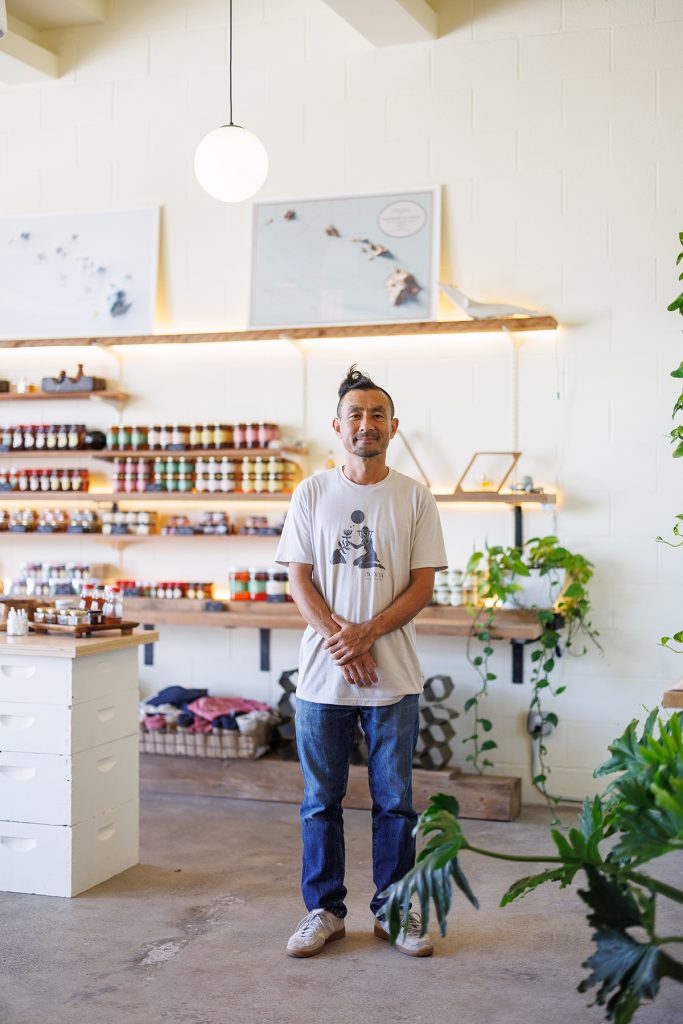
Photo: Aaron K. Yoshino
Often associated with Vikings and medieval feasts, mead is, at its heart, created simply, through the fermentation of honey and water—a tradition that spans thousands of years across various cultures. In Hawai‘i, Yuki Uzuhashi, owner of Mānoa Honey & Mead, is reimagining the ancient drink through an Island perspective, bringing mead to the forefront of Hawai‘i’s craft beverage scene. Rather than reproducing a heavy, traditional style of mead, Uzuhashi has developed a style that is bright, lively and expressive of the Islands, using locally sourced honey and Island-grown ingredients to showcase Hawai‘i’s unique agricultural flavors.
After graduating from art school in Japan in 2003, Uzuhashi made an unusual declaration for his thesis project: He would become a beekeeper. What began as an artistic vision soon evolved into a life calling. Following graduation, Uzuhashi apprenticed under a beekeeper before launching a small independent operation with his grandmother in 2005.
Years later, a chance trip to Hawai‘i altered the course of his career. During the visit, Uzuhashi met the founder of Mānoa Honey & Mead, who was preparing to retire. Seeing an opportunity to carry his legacy forward, Uzuhashi and his wife, Erika, made the leap and relocated to Hawai‘i in 2014. Today, the couple operates the family-run business, focusing on small-batch production and high-quality ingredients. Their offerings have expanded beyond raw honey to include specialty hive products and, notably, O‘ahu’s only craft mead production facility, bringing new attention to an ancient beverage.
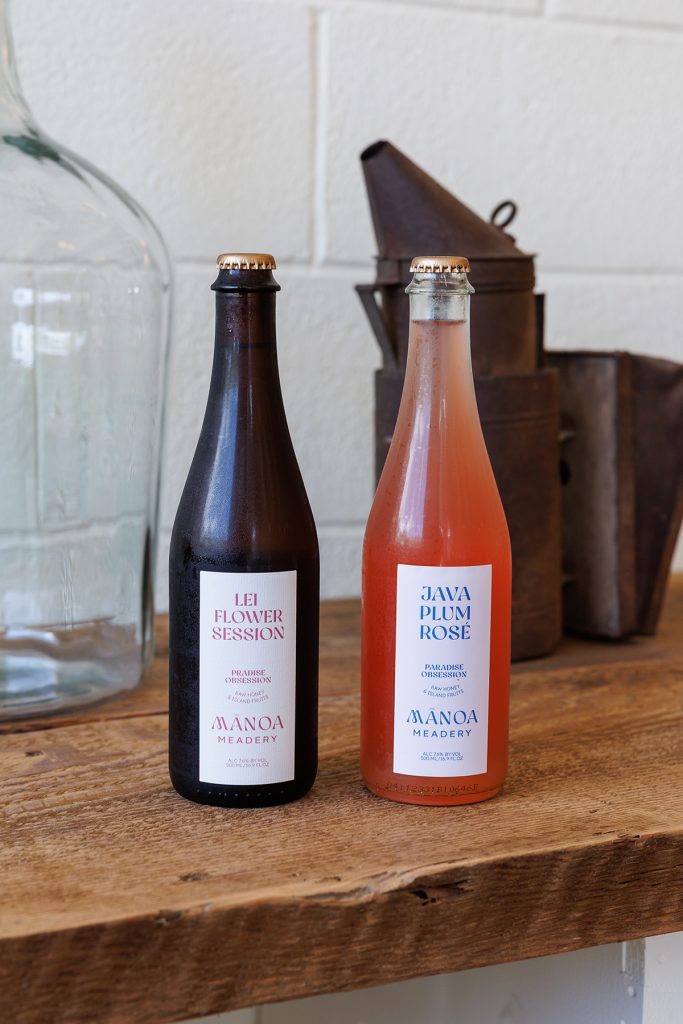
Photo: Aaron K. Yoshino
While their mead was officially launched during the Covid-19 pandemic, Uzuhashi says the groundwork began years earlier. In 2017, he enrolled in a mead-making course at UC Davis and later formalized his recipe after receiving a USDA value-added grant. From the outset, he set out to create something distinctly suited to Hawai‘i.
“Over the course of developing our recipes, we could not find a role model or style of mead to follow, because our climate in Hawai‘i is so unique,” he recalls. “We are in a humid and warm climate, reaching for things that are refreshing and unlike traditional meads that are heavier and higher in alcohol. Therefore, we created a mead that made sense to us, something bubbly, meant to be drunk cold, and using the iconic fruits of the Islands.”
Still, Hawaiian-grown honey is at the heart of his work, and the health of the Islands’ hives are a constant concern. “Weather, rain, invasive parasites—they are all risks to the health of hives,” he explains. “The health of hives is 100% a concern to us. Without healthy bees, we do not have anything.”
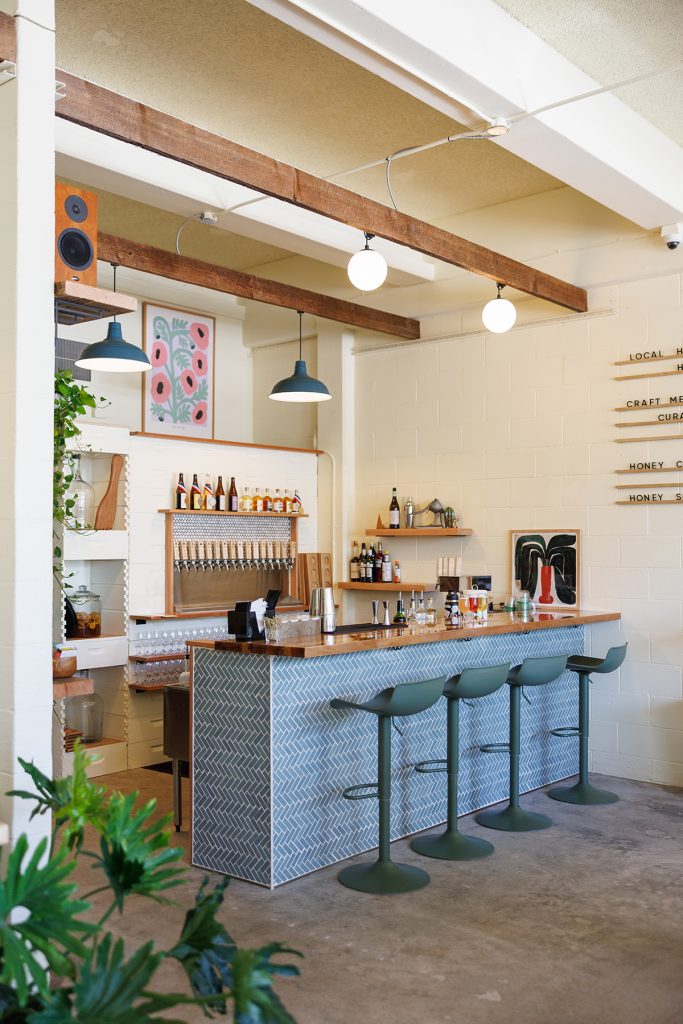
Photo: Aaron K. Yoshino
Despite these challenges, Uzuhashi remains busy as a bee, expanding operations to include a retail and meadery location in Wahiawā as well as a new tasting room in Kaimukī, all while continuing to develop meads rooted in place. “We are working to create a super terroir-centric beverage,” he shares. “When you are drinking our mead and looking into the floral trees, you are looking at the flowers that you are getting a buzz from; you are tasting harmony, and isn’t that a beautiful thing?”
Today, the story of honeybees in Hawai‘i stands as one of both transformation and interdependence, an imported species that quietly reshaped the Islands’ landscapes, economy and flavors. Their presence is now inseparable from the rhythm of Island life, woven into agriculture, ecology and culture alike. In every drop of honey and every glass of mead, there is a reminder of how something so small can leave such an enduring imprint.
For more information about Mānoa Honey & Mead, visit manoahoney.com.
Want to read more?
Check out the full article on the original site