What Is a ConRo Ship? ConRo Vessel vs. Container Ships Explained
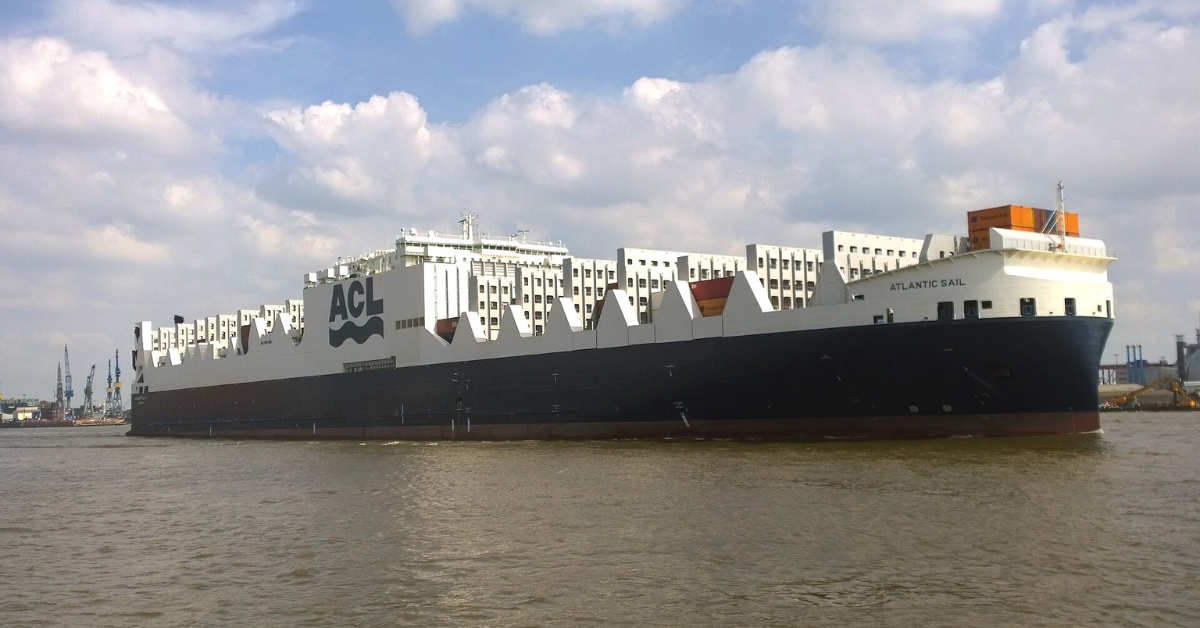
Definition: RoRo container ship, or ConRo, is a specialised vessel that can transport both vehicles and shipping containers at the same time.
The ConRo vessel carries vehicles or wheeled cargo on enclosed decks and usually stacks shipping containers on the upper decks.
A conventional Roll-on/Roll-off (RoRo) ship transports vehicles, whereas a containership transports standardised shipping containers. ConRo is a hybrid vessel that does both.
ConRo ships, or RoRo container ships, are designed to load and unload vehicles onto their deck without shore cranes. Wheeled cargo drives on and off the vessel using built-in ramps, which can cut port time to as little as 24–48 hours compared with crane-dependent container ships.
The lower decks of ConRo vessels are enclosed and fitted with internal ramps, much similar to dedicated car carriers. The vehicles are driven aboard and lashed to the deck. The upper decks are open and structured like a conventional container ship, where shipping containers are stacked.
Not all ConRo vessels are designed the same way. Some carry shipping containers in cargo holds alongside vehicle decks, which are fitted with container sockets and lashing points. The container holds have cell guides (a standard feature of container ships) that help stack containers tightly and keep them secure.
CEU and TEU
As a hybrid vessel with different cargo types (containers and vehicles), ConRo measures capacity using multiple metrics.
The three main units that are used are:
1. TEU (twenty-foot equivalent units) container capacity
ConRo container capacity is measured by the number of standard 20 ft containers the vessel can carry. TEUs is the same metric that is used for container ships.
2. Lane metres or linear metres.
Lane metres is the standard metric for measuring vehicle cargo in RoRo container ships. Lane metres is the total length of vehicle cargo lanes across all decks.
3. CEU or Car Equivalent Units
This is also a common metric to measure the capacity of pure car carriers (PCTCs). It denotes the number of vehicles the ship can accommodate.
Loading Method and Transit Time
ConRo vessels can load and unload vehicles onto their deck without shore cranes. The vehicles drive on and off the vessel using ramps.
RoRo container ships use a hybrid loading system that combines roll-on/roll-off operations for vehicles and lift-on/lift-off operations for containers.
They have ramps (usually stern ramps) for vehicle loading, which are lowered onto the berth to create a drive-in platform. Wheeled cargo, such as cars and trucks, is driven directly into the vessel using its own power.
Once inside the vessel, the vehicles are moved to different decks using internal ramps and then secured with lashing and chocks according to the stowage plan. As the vehicles are driven using their own power, no shore crane is required for the loading of wheeled cargo.
For loading containers, port gantry cranes carry out traditional LoLo (lift-on-lift-off) operations. Containers are stacked in dedicated cargo holds or cell guides, as on pure container ships. The container loading area is usually separated from the wheeled cargo decks.
ConRo ships require both ramp access and crane access for vehicles and containers, respectively, to run two operations in parallel. As vehicles load and unload onto the ConRo ships using their own power, they depend less on port equipment and support. This leads to faster port turnaround and shorter port time with considerably less handling risk.
Cargo protection on ConRo ships
ConRo vessels provide strong protection from harsh weather at sea. The enclosed decks protect vehicles, while shipping containers are handled as on any other container ship.
RoRo Cargo: Because wheeled cargo is stored on multi-level internal decks inside the ship, with no direct exposure to the harsh environment, it poses a significantly lower risk to the cargo. There is also less risk of corrosion because it is not directly exposed to ocean saltwater spray, which is common in open-deck transport or flat rack containers. The only significant weather exposure occurs during loading or unloading at the ramp. The wheeled cargo is properly latched and chocked to the deck according to the stowage plan, minimising damage from cargo shifting during heavy weather.
Container Cargo: Standardised shipping containers on ConRo vessels are handled like any other container ship. They are stacked on the container decks and are exposed to the environment. The cargo is protected only by the steel walls and doors of the shipping containers. Thus, the cargo’s weather protection (temperature, humidity, and saltwater) depends mainly on the condition of the shipping container, dunnage quality, and the type of container used.
Disadvantage of ConRo vessels
ConRo vessels are among the most versatile ships in the modern shipping fleet, combining container capacity with roll-on/roll-off (RoRo) capability. However, there are some structural and operational disadvantages of this vessel type. ConRos requires specialised berths with heavy-duty ramps and quays, which most of the standard terminals do not have. As a result, it has access to only a limited number of ports and must follow a fixed route.
ConRoS also have cargo-related restrictions that prohibit carrying loose spare parts, including tools, extra tyres, replacement boxes, etc., along with the vessels; only factory-fitted accessories and parts are allowed due to safety and customs regulations.
Some operators also restrict hazardous or high-risk cargo on RoRo decks, making ConRos less suitable for mixed shipments.
Despite enclosed RoRo decks, wheeled cargo still faces a high risk of handling damage. Vehicles are driven, repositioned, and re-lashed multiple times, increasing the chance of scrapes, battery trains, or tyre and brake wear. For high-value or classic vehicles, this risk matters because there is no additional protection during transport.
On the technical side, ConRo vessels, just like RoRo ships, suffer from stability issues. ConRo vessels are designed with large, open vehicle decks and limited watertight subdivisions so cargo can be distributed efficiently. If water enters these deck spaces, it can spread freely across the wide deck, creating a strong free surface effect that rapidly reduces the vessel’s metacentric height (GM). Even a small layer of water on the deck can significantly disturb the ship’s stability, especially when combined with high centre-of-gravity cargo and heavy weather.
ConRo ships are complex hybrid vessels that are expensive to build and maintain. With only a few dozen ConRo ships operating globally, the number of operators and vessels remains limited.
Want to read more?
Check out the full article on the original site