U.S. Navy Gets First Payload Module For Virginia-Class Submarine USS Arizona
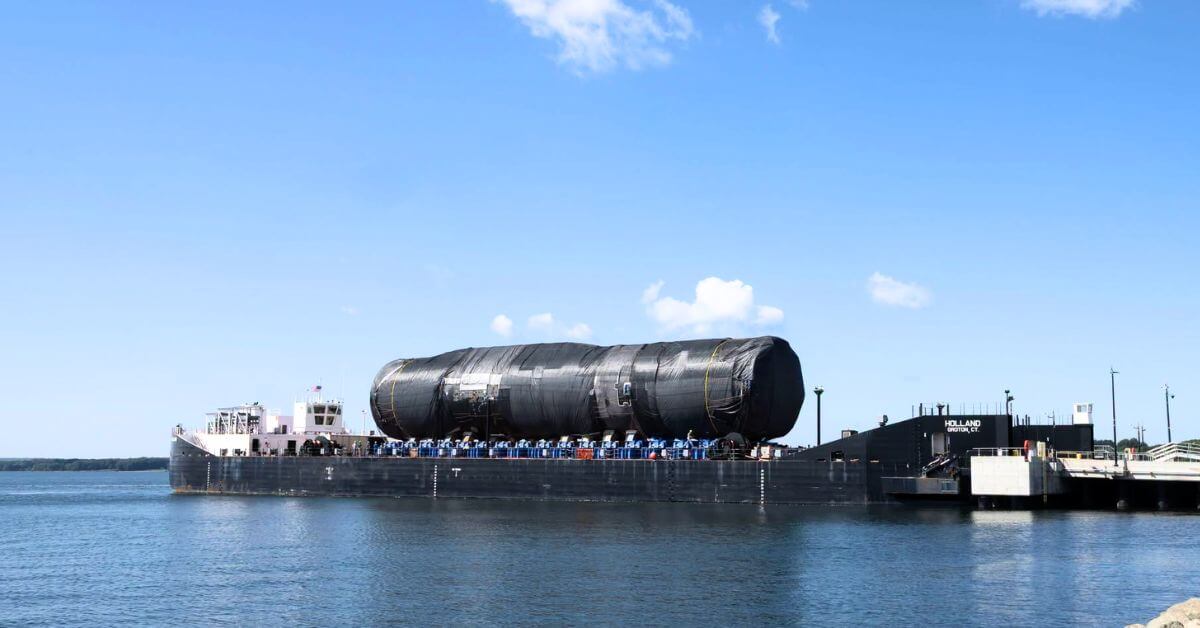
General Dynamics Electric Boat has completed the first Virginia Payload Module (VPM) for the U.S. Navy’s Virginia-class submarines.
The 184-foot section was moved by barge from Quonset Point to Electric Boat’s facility in Groton, Connecticut. It will be installed on the future USS Arizona (SSGN-803).
Electric Boat said the move was the largest Virginia-class section shipment so far.
The VPM will give Virginia-class submarines space for up to 28 more Tomahawk-sized missiles. The module can also carry Conventional Prompt Strike (CPS) hypersonic boost-glide weapons.
The extra missile space will help replace some of the capacity now provided by four converted Ohio-class submarines as those older boats leave service.
Electric Boat shared a photo of the section on Facebook. The company said the USS Arizona will be about 460 feet long when finished.
The VPM has four large canisters. Each canister can hold seven Tomahawk-sized missiles. Together, they can carry up to 28 missiles.
The submarine also has two Virginia Payload Tubes in its bow. Each tube can hold six missiles. This gives the submarine a total vertical-launch capacity of up to 40 missiles.
The VPM can also be used for CPS weapons instead of Tomahawk-sized missiles. Each of its four canisters can hold three CPS hypersonic boost-glide weapons.
The Navy uses the same CPS mounting systems on Zumwalt-class destroyers after their conversions. The larger launch system could also be used for other weapons.
Naval News has reported on work to develop a submarine-launched version of the AARGM-ER anti-radiation missile. The missile would give U.S. submarines a way to target radar systems.
The War Zone has also reported on an effort to give submarines an anti-air capability using a version of the Navy Modular Missile. It is the Navy’s prospective next-generation interceptor and is expected to be used from submarine vertical-launch systems.
19 Submarines to Get the VPM
USS Arizona will be the first U.S. Navy submarine to receive the VPM. It is expected to be the second Block V Virginia-class submarine to enter service, after USS Oklahoma (SSN-802).
The Navy plans to put the VPM on 19 Virginia-class submarines. This includes 12 Block V and seven Block VI submarines. The upgrades are planned over the next two decades.
Each submarine with a VPM will be 83 feet longer than earlier Virginia-class boats.
The VPM section itself is about 184 feet long. The completed submarine will be about 460 feet long.
The 19 submarines will also have upgrades already introduced on earlier Virginia-class boats. These include a side-mounted sonar array first used on the Block V submarines.
Replacing Older Ohio-Class Capacity
The VPM will also help replace missile capacity that will be lost when older Ohio-class submarines leave service.
The first four Ohio-class submarines were converted in the early 2000s. They were changed to carry conventional weapons instead of their original 16 Trident submarine-launched ballistic missiles.
Each converted submarine can carry 154 Tomahawk land-attack cruise missiles.
The conversions allowed the four submarines to stay in service instead of retiring early. They now provide most of the U.S. submarine fleet’s conventional vertical-launch capacity.
But the four submarines are more than 40 years old and will eventually leave service.
Their retirement will create a gap in conventional VLS capacity.
The VPM-equipped Virginia-class submarines are planned to replace that capacity and spread it across more modern submarines.
When all 19 VPM-equipped submarines are in service, the Navy will have more VLS cells overall.
In July, General Dynamics Electric Boat received a $42.1 billion contract to build nine more Virginia-class submarines.
References: navalnews, forbes
Want to read more?
Check out the full article on the original site