Indonesia’s First Aircraft Carrier Reaches Jakarta Amid Debate Over Cost & Naval Ambitions


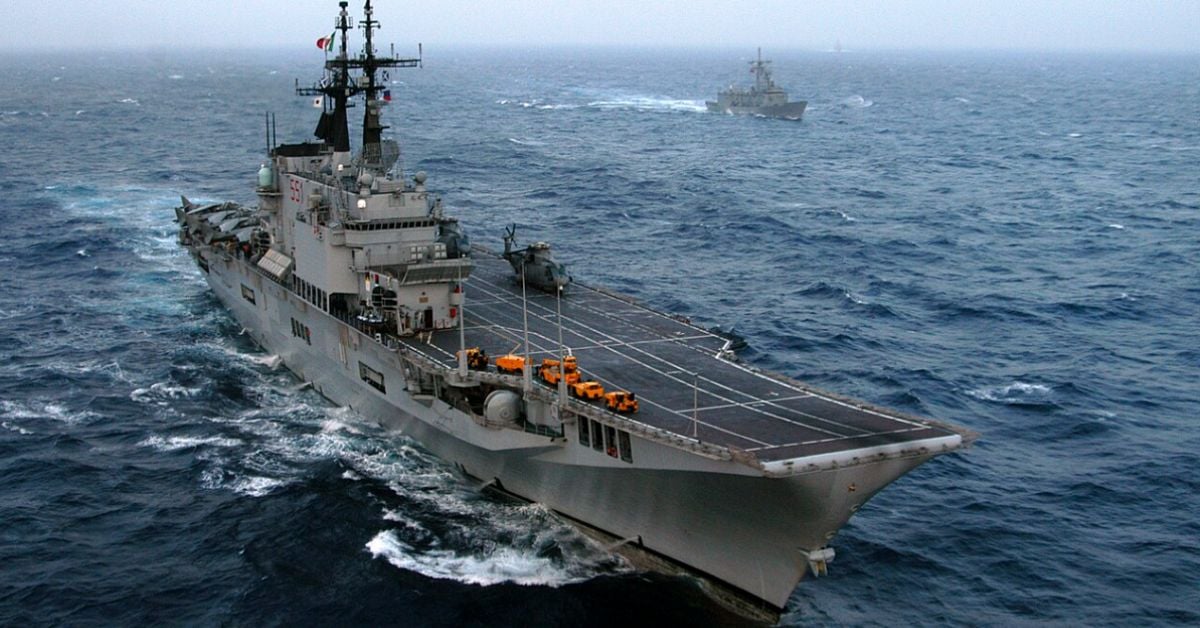
Italy’s warship Giuseppe Garibaldi has been acquired by Indonesia and is set to become its first-ever aircraft carrier. The vessel, which will be renamed KRI Sriwijaya, left Italy’s Taranto on 24 August for Jakarta.
It had a mixed Indonesian and Italian crew during the journey to Southeast Asia, in which it sailed via the Suez Canal and stopped at Egypt’s Safaga and Sri Lanka’s Colombo ports.
To ensure its safety, Italian warships provided escorts when it passed through the Red Sea, where shipping is being threatened by renewed Houthi attacks.
Unlike the two frigates earlier acquired from Italy, the future aircraft carrier of Indonesia entered its territorial waters via the Malacca Strait and not the Sunda Strait.
When it was in Indonesian waters, two Navy PPA’s, KRI Brawijaya (320) and KRI Prabu Siliwangi (321), escorted it, and a maritime patrol aircraft welcomed it.
The aircraft carrier will berth at Tanjung Priok Port in Jakarta and serve as a highlight of the upcoming Indonesian National Armed Forces’ anniversary celebrations scheduled for 5 October.
According to statements by the navy, the ship would focus on Military Operations and not war. It would participate in humanitarian and disaster relief operations when required.
Before its arrival, the Indonesian military also conducted shipboard helicopter drills involving the AS565 Panther of the Navy, the NAS332 Super Puma of the Air Force and the Army’s Bell 412.
The training included deck takeoff and landing practice and live flight operations from the landing platform dock KRI Makassar.
This joint initiative is important to integrate the vessel into service and familiarise crews across all three military branches with the shipboard flight operations.
The aircraft carrier was to to be named KRI Gadjah Mada; the Indonesian Navy ultimately designated it KRI Sriwijaya.
The new name honours the ancient thalassocracy based in Sumatra, which controlled crucial regional maritime trade routes and held extensive influence across maritime Southeast Asia for many centuries.
Want to read more?
Check out the full article on the original site