Can Fragrance Really Make You More Confident? Here's What Experts Say

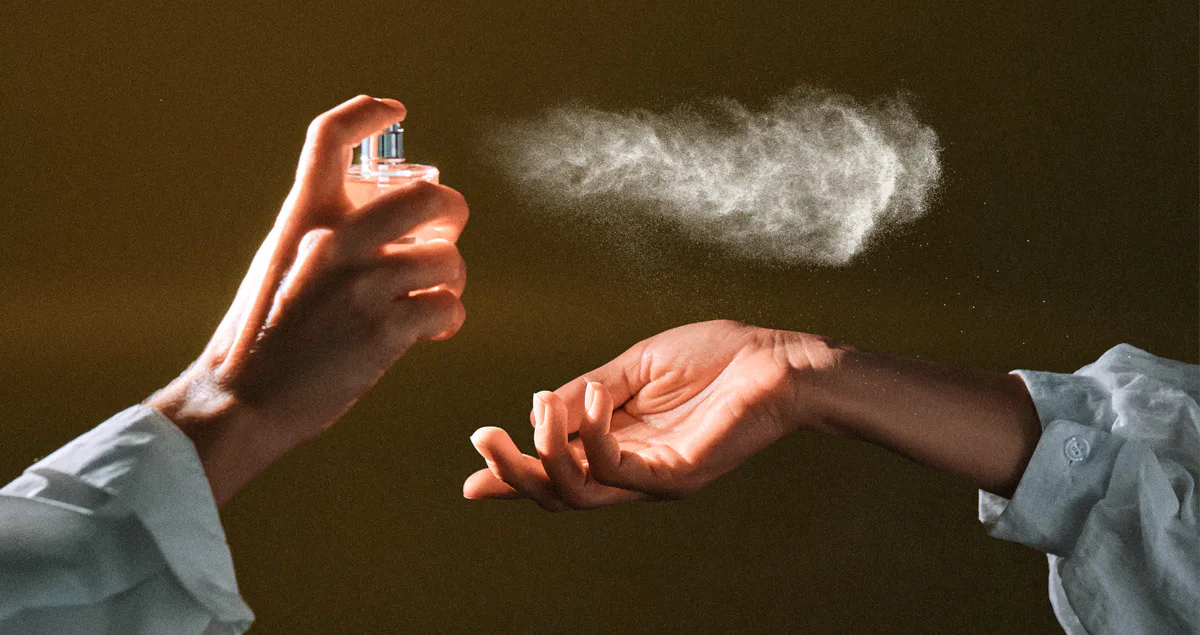
Perfume ads are almost endearing with their predictability: Gorgeous model and/or celebrity wears incredible clothing and stares pensively at the camera while intoning intentionally vague declarations in a breathy voice, before a dramatic shot of the bottle appears on screen. They present you with a version of yourself you want to be: admired, unobtainable, chic, confident.
But what if a scent could do more than cultivate a fictional persona? What if it could physiologically change how you feel about yourself with every sniff? That’s the question purveyors of functional fragrances are asking, as a swell of new perfumes with scientific claims hit the market, with promises to change your mood with the power of smell. Sound familiar?
Functional Fragrance Is The New Aromatherapy
Anyone who was around for the random New Age revival in the ‘90s is intimately familiar with this concept. Aromatherapy felt like it was everywhere you turned, with essential oils in everything from diffusers to roll-on perfumes. But the new crop of functional fragrances is doing more than just making vague promises about energizing or calming — they’ve teamed up with neuroscientists to make mood-altering claims backed by research and neurological testing.
Take, for instance, fragrance manufacturer Givaudan’s new mood-lifting MoodScentz+ formulas. “Traditional aromatherapy draws on essential oils and long-standing practice; Givaudan’s MoodScentz+ fragrance technologies create multifaceted, carefully layered fragrances, which prove the benefit on the finished scent using validation tools and brain imaging techniques, rather than inferring effects from a single or blend of essential oils,” explains Marion Coureault, marketing manager for science and technology at Givaudan. Instead of focusing on just a singular essential oil note, Givaudan has created a portfolio of scent combinations that have been tested using everything from MRIs to EEGs to see how the brain actually responds.
In today’s extremely noisy world, shifting your mindset with scent sounds less woo-woo neo-hippie and more like a wellness practice. “People are dealing with more stress, stimulation, and digital overload,” says Jules Miller, founder of The Nue Co., one of the OG functional fragrance brands. “They are looking for small, accessible rituals that can help them transition between emotional states without adding another complicated step to their day. Fragrance is uniquely suited to that because it is immediate, portable, and pleasurable. You can use scent before a difficult meeting, during a commute, or whenever you want to reset the tone of a moment.”
Confidence In A Bottle?
Perhaps this is why scents promising a measurable increase in confidence levels are the hottest trend in fragrance. Earlier this year, fragrance brand Vyrao launched the latest addition to their neuroscience-backed collection of scents, Ever 11. A blend of black cherry, leather, patchouli, rose, vanilla, and peony, it boasts the claim of being neuroscientifically tested to improve self-esteem by 97%, as measured by International Flavors & Fragrances’ (IFF) proprietary Science of Wellness program. The Nue Co. has a wardrobe of scents that promise to calm stress and energize, while bath and body care brand Joonbyrd is debuting its first foray into fragrance this October with a trio of Mood Jellies — solid functional fragrances for confidence, happiness, and calm inspired by neuroscientific research.
“Fragrance has been an important part of Joonbyrd since we launched,” says Dr. Alexis Granite, M.D., a board-certified dermatologist and founder of Joonbyrd. “We believe efficacy and sensorial experience are both important in creating rituals we want to return to. With Mood Jellies, we took that philosophy a step further by working with fragrance houses that have developed specific neuroscience-based fragrance technologies.” The brand worked with fragrance developers to study how different fragrance compositions relate to emotional response, she explains. That includes both consumer emotional response testing and more objective measures like heart rate, skin conductance, EEG, and fMRI to help understand how exactly the body responds to different fragrances.
“Confidence Mood Jelly was developed around an invigorating fragrance direction associated with energy, vitality, and an uplifted frame of mind,” says Granite. The final scent is a mix of peach, oak moss, saffron, and ambroxan, and she notes that it’s both the combination of ingredients and the way they work together that is significant. “When we talk about neuroscience and fragrance, we aren't suggesting that an MRI can simply show that someone ‘feels confident,’ as emotional response is nuanced,” she says. “What neuroscience gives us are objective measures of how the brain and body respond to fragrance, which can be considered alongside a person's reported emotional responses. Humans have intuitively understood for centuries that scent can change how we feel. Now we have sophisticated scientific tools to understand how and why.”
How Scent Impacts The Brain
There is a fascinating science behind how your brain perceives scent and the correlation between mood and fragrance. According to Nathalie Mandairon, Ph.D., a neuroscientist and research director at the French National Centre for Scientific Research (CNRS) and director of NeuroPop at the Lyon Neuroscience Research Center, our brains process scents uniquely from our other senses. “In sensory systems, such as vision or taste, sensory information passes through the thalamus before reaching the cortex. Olfaction is unique in that it can reach its primary cortical areas and limbic structures without this initial thalamic relay,” she explains. “For perfume, this is particularly relevant: a fragrance is not simply processed as a sensory stimulus, but can very rapidly engage brain circuits involved in emotion, memory, and reward.” She notes that it’s this connection between your limbic and reward systems that explains why a scent can evoke powerful memories or emotions — even if you can’t directly identify the smell itself.
That’s not to say we have a treasure map that tells us certain scents will elicit specific responses. How you interpret a scent is extremely dependent on your past relationship with that aroma. “There is no direct and universal relationship between a specific odor and a particular emotional state,” says Rachel Herz, Ph.D., a neuroscientist, expert in the psychological science of scent, faculty member at Brown University, and author of Why You Eat What You Eat. “If you have associated a specific emotion with a particular odor, that odor — upon later exposure — will elicit that emotional state.” Meaning everyone has a different experience with a scent because it truly depends on the emotion you subjectively experienced when smelling it. And, as Mandairon points out, there is no such thing as a universally pleasant odor. “Scent perception can differ considerably from one person to another,” she says. “Learning, previous experiences, and cultural background can strongly shape how we perceive an odorant and, in particular, whether we find it pleasant or unpleasant.” The French scientist uses Camembert cheese as an example: For someone like herself who grew up eating it, that distinct aroma can be associated with something pleasant and appetizing, whereas someone not familiar with it may find it stinky and unappealing.
That said, she does note that CNRS research has recently shown that scent is not entirely subjective. “On average, some odorants tend to be perceived as more pleasant and attractive, while others tend to be perceived as more unpleasant or repulsive,” Mandairon explains. “Citrus-like odors (limonene) are generally rated positively, whereas odorants associated with smoke (guaiacol) or potential danger tend to be perceived more negatively.” Studies in both mice and humans have shown that attractive scents can trigger a dopamine release into the reward system area of the brain, she says. “So there is a real neurochemical basis for the effects of odorants on the brain, but the relationship between a specific fragrance, a specific neurotransmitter, and a specific mood is more complex than a simple one-to-one relationship, as our responses to odors can be strongly shaped by learning, previous experience, and culture.”
Fragrance With Function
Because of this deeply personal and subjective experience, Herz says that it makes it difficult for a perfume to have a uniform effect on everyone who smells it. She acknowledges that the current crop of functional fragrances has the right idea, because they aren’t depending on a specific note to create the effect, but rather crafting entirely new scents. “If there's a scent that people are already very familiar with — and through their life experiences have prior associations to it — it is extremely difficult, if not impossible, to create a new one,” she says. “I couldn't suddenly make coffee the scent of confidence for you if it had nothing to do with that in the past.”
For Miller, that is exactly why The Nue Co. doesn’t start their functional scents by targeting a specific note, but rather a specific mood. “We begin with the emotional state we want to support — whether that is calm, energy, focus, connection, or joy,” she says. “We then work with fragrance and technology partners to explore accords that research and testing suggest may be associated with that emotional response. The science helps us identify patterns across groups of people, but it does not suggest that every person will have an identical reaction. Functional fragrance can help create the conditions for a particular mood; it is not an emotional on-off switch.”
For perfumers, the challenge of translating scientific data into a fully realized scent can be easier said than done. “It is the craft of the perfumer to combine specific olfactive categories associated with a specific mood benefit in a way that is harmonious with the other notes in the fragrance,” says Givaudan Master Perfumer Stephen Nilsen. If that wasn’t tricky enough, Nilsen explains that they are often balancing notes that have contradictory functional benefits, like energizing orange with relaxing lavender. “In those cases, the perfumer needs to alter the fragrance to focus on delivering the requested benefit,” he says. In typical scents, perfumers are blending notes to create an attractive scent. With functional fragrances, they not only are looking at the science on the notes they are working with, but attempting to create something that smells unique, enhances mood, and that you actually want to wear.
Control Your Narrative
While functional fragrances can potentially influence mood, ultimately, it is up to the wearer of the perfume to ensure that a fragrance has a positive influence on how they feel about themselves. “A scent will change your mood and can make you feel better, but it is your particular experience, your particular linking of it [that creates the confidence boost],” says Herz. She recommends purchasing a new scent when you are feeling confident or really positive about yourself. “You have a better chance of making it work if you're in a really great mood, feeling on top of the world, and you get a new fragrance. Then later when you're feeling down, you sniff it again, and you’ll get this great boost.”
Miller emphasizes the importance of ritual to bridge the gap between fragrance and emotion. “We look for statistically meaningful responses across a diverse group,” she says. “Some people may feel an immediate emotional shift, while others may experience the fragrance as a cue that becomes stronger through repeated use. If you consistently reach for a particular scent when you want to wind down, focus, or reset, your brain can begin to associate that fragrance with the intended state. The fragrance supports the moment, while repetition can help reinforce the connection.”
As Coureault puts it, scent is a tool, not a cure. “Think of fragrance as a short, reliable ritual that helps put you in the right mindset rather than a standalone fix,” she says. Focus on context and timing, she suggests, using an energizing scent as part of your morning routine, for instance, or a confidence booster before a big presentation. “The same fragrance will work best when paired with a matched activity or ritual, because context shapes how the brain interprets the smell and draws upon previous experience to reinforce the positive mind state when using a functional fragrance,” she notes.
Spritz Responsibly
Just don’t overdo it, as it turns out nose blindness with perfume can diminish the positive mood benefits you may have cultivated. “The more we stick our nose in a bottle, the less we are actually able to detect the scent,” says Herz. It’s both a short-term (adaptation) and long-term (habituation) effect. With adaptation, she says, our noses stop responding to the chemicals of the scent. “Habituation is where, even if you take a break from the smell, because it's in the environment all the time, we literally stop being able to smell it. A classic example [of adaptation] is you walk into the bakery, and it smells amazing, but if you’re in there for 20 minutes, you are no longer able to smell the ambient air around you.” You might walk back in and be able to smell the bakery again, she says. Habituation is when someone who works at the bakery, despite going home for the day, can’t smell the baked goods when they return because they are surrounded by it so frequently.
That physiological response is the same for your favorite fragrance. “If you are constantly wanting to feel confident and going back to the same fragrance, it is going to quickly lose its emotional impact on you,” says Herz. If your scent receptors are not able to detect it, you most likely are not going to feel that mood boost associated with it. So even if you are able to connect increased confidence with a certain fragrance, you have to be mindful of how often you use it. “After that connection is established, if someone is constantly exposing themselves to that scent and hoping that they will get this boost of confidence each time, that is going to quickly start having diminishing returns,” says Herz.
Enhancing your mood with a functional fragrance sounds like an appealing form of self-care, and experts agree that there is neuroscience-backed research that can help support at least the basic premise of those confidence-in-a-bottle claims. But that doesn’t mean you need to throw out your entire perfume portfolio and adopt fragrance therapy as your new signature scent. “Research has demonstrated overlapping neural circuitry between olfaction and emotion and has shown that fragrance can influence our psychology and physiology,” says Granite. “That said, we also don't need to overcomplicate every fragrance, and sometimes a beautiful scent can simply be enjoyed as just that.”
Want to read more?
Check out the full article on the original site